

How and Why Rudy Guede Was a Lone Wolf Assailant in the Murder of Meredith Kercher
A warm All Things Crime Blog welcome to our newest contributor, Michael Mills. Here Michael provides us with a compelling hypothesis into how and why Rudy Guede acted alone in the murder of Meredith Kercher.
by Michael Mills
I would like to suggest an alternative hypothesis to explain some of the anomalies about this case.
The basic elements of my hypothesis are:
1. The murder of Kercher was committed by Guede acting alone, after having been admitted to the house by Kercher, with whom he was acquainted.
2. The murder was discovered some later time by Knox, after she returned to the house. Fearing that the murder had been committed by someone known to both her and Kercher, and that her likely connection to the murderer might cause her to be suspected, she and Sollecito carried out a partial clean-up of the crime scene, and staged the break-in in order to deflect attention away from anyone connected to her.
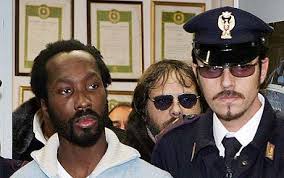 In developing that hypothesis, I am relying to a considerable degree on Guede’s first statement to the German police on 21 November, after his arrest in Germany and before his extradition to Italy. The statement has probative value since it was made to the German police, who had no vested interest in the case, and before the Italian police could get hold of him and start to influence his story.
In that first statement, Guede claimed that he had been admitted to the house by Kercher, with whom he was acquainted, and that they had had low-level sexual contact. He describes Kercher finding money missing from her desk, and going into Knox’s room to search for it. At that point in his statement, he declares that Knox was not there, obviously to explain how Kercher could have searched Knox’s room.
I find nothing incredible about Guede’s claim that Kercher was acquainted with him and admitted him to the house willingly. He had previously visited the house, and was acquainted with the boys who lived in the bottom apartment, including Kercher’s boyfriend.
That claim is an adequate explanation of how he got into the house, assuming that he did not break in, a reasonable assumption given the indications that the signs of break-in were manufactured.
 His story of having consensual low-level sexual contact with Kercher is less credible, and probably designed to explain away how his DNA came to be on her body. It is, however, not impossible; the only reason why it has been dismissed out of hand is because of the idealised picture of Kercher painted by her family and friends.
The story of Kercher searching for missing money is also unlikely; its purpose was probably cover the fact that he himself had taken money from Kercher’s purse after the murder (his bloody fingerprints were found on and in that purse).
Guede also claimed to have had a conversation with Kercher, in which she complained about Knox smoking hashish. It is difficult to see how they could have had anything other than a very limited conversation, since Guede reportedly knew limited English and Kercher’s Italian was also limited.
Guede then claims that he was in the toilet for an extended period of time, during which Kercher was killed by an unknown intruder. Hearing her screams, he stumbled out of the toilet, pulling up his pants. He sees an unknown man shorter than himself and grapples with him, but the man gets away and runs out the door to the house.
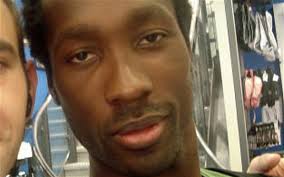 Guede claims he found Kercher badly wounded and dying, and that he tried to comfort her. He claims she tried to say something to him, and that he attempted to write down what she said with a finger dipped in her blood. After she finally died, he left the house and went home, telling nobody what had happened.
It is fairly obvious that Guede’s account of remaining with Kercher and trying to comfort her is an attempt to explain away the evidence of his having been in the room, e.g., fingerprints and DNA. Nevertheless, a lot of the graphic detail in his account of her dying is probably real, based on his actually having been in the room and having seen her die.
It is most likely that Guede himself committed the murder, and that descriptions of the unknown man and his actions are simply a projection of himself and his own actions; e.g., after killing Kercher and stealing money from her purse, he walked straight out of the house, exactly as he described the unknown man doing.
 A further indication that it was Guede who committed the murder is that he provides no clue as to how the mysterious man gained entry to the house. Since the only person to have been admitted to the house by Kercher was himself, and there is no credible evidence of a genuine forced entry, then the only persons who could have been in the house at the time of the murder were Kercher and Guede.
The most crucial element in Guede’s statement to the German police is his affirmation that the murder was committed by one man acting alone. Although he claims that that one man was someone other than himself, that is unlikely to be true; the murderer was almost certainly himself, a person who had been admitted to the house by Kercher.
It is claimed by the Prosecution that one person could not have subdued Kercher since she was very strong and had learned karate. That claim is again based on the idealised image of Kercher painted by her family and friends; there is no reason to doubt that a fairly athletic young basketballer such as Guede could have subdued and killed Kercher, particularly if he took her by surprise.
The most likely motive for Guede killing Kercher was sexual; i.e., he wanted to have sexual activity with her, but she refused. That could possibly explain why the killer continued to cut her body, in addition to inflicting the fatal neck-wounds.
Guede’s actions after leaving the house also indicate a criminal personality capable of murder. He just went home, and then spent the night in a disco and bar. The next day he left for Germany, indicating guilt and an attempt to evade justice.
 In summary, according to his own admissions, when he entered the house, Kercher was alive, and when she left it she was dead. Logically, the murder was committed between the time he entered the house and the time he left it. He explicitly states that Knox was not there. If we dismiss his claim that the murder was committed by an unknown man who gained access by unknown means, then he and Kercher were the only persons present in the house from the time of his arrival until the time of his departure, and it therefore follows that he alone committed the murder.
In my next post, I will offer a theory about the subsequent actions of Sollecito and Knox.
Michael Mills is a retired Australian Public Servant. He is 66 years old, has a keen interest in history and current affairs, and posts regularly on online history forums. Like many, he was appalled by the recent re-conviction of Amanda Knox and Raffaele Sollecito, and after substantial intensive research, he has developed the theory of the case that he sets forth herein.
If you enjoyed this article, please consider sharing it!


Michael – You’ve posited an interesting theory of the Kercher murder. The only problem with attaching much weight to Guede’s statements is that his testimony is unbelievable as to certain key details (i.e., that he had “low-level” sexual contact with Kercher and that he helped Kercher search for some missing money). If so, don’t you have to disregard Guede’s testimony in its entirety and instead rely strictly on the forensic evidence?
No, there is no good reason to reject Guede’s testimony in its entirety.
What is needed is an analysis of it against other evidence, to determine which parts of it are possibly true and which parts are almost certainly untrue.
For example, his statement made to the German police is consistent with the forensic evidence of his presence in Kercher’s bedroom.
One item of forensic evidence was traces of Guede’s DNA found inside Kercher’s vagina, but without any evidence of semen. That is consistent of Guede’s claim of low-level sexual contact with her, eg inserting a finger in order to stimulate her to orgasm.
It is also consistent with his claim that she willingly admitted him to the house. What he claimed is that when he arrived at the house, Kercher was not there, so he waited until she arrived, at which point she admitted him. That is consistent with the testimony of Kercher’s British friends, who stated that on the night of 1 November 2007 she left them to return home by herself at about 21:00.
Kercher was acquainted with Guede due to the fact that he was a friend of the four young men who lived in the downstairs apartment, with one of whom she had started an intimate relationship. Guede had visited his friends in their apartment, and Kercher had previously met him there.
It is entirely possible that Kercher found Guede sexually attractive; he was young, athletic and Black, characteristics that many young women are drawn to.
Accordingly, there is no reason to reject out of hand Guede’s claim that Kercher willingly let him into the house at around 21:00. His claim that he and she had low-level sexual contact is also possibly true, since it is consistent with the forensic evidence, but is not necessarily true.
One possibility is that Guede wanted to take the low-level sexual contact further, to full sexual intercourse, that Kercher refused due to her relationship with one of the young men living in the house, that Guede then tried to force her using physical violence such as holding her wrists and banging her head on the ground, and finally pulled out his knife and killed her.
His description of what he did after the murder (which according to him was committed by an unknown intruder while he was in the toilet) suggests a psychopathic, uncaring character capable of killing; he says he just went home, and in fact he was observed later that night in a disco and bar.
You’ve made some excellent points, Michael. One way to view Guede’s testimony if one doubts his veracity is to credit those statements which tend to inculpate him (on the theory that they are admissions or statements against his penal interest) and to disregard those statements which exculpate him. It appears that this may be the approach that you’ve followed (consciously or subconsciously) in analyzing his statements to the German police.
[…] How and Why Rudy Guede Was a Lone Wolf Assailant in the Murder of Meredith Kercher […]
So in order for Amanda Knox and Raffaele Sollecito to not be considered suspects, they clean up part of the crime scene, lied about where they were the night before, she accuses an innocent man and knows that Meredith was killed the night before the police were called to break the door down? DOES THAT REALLY MAKE EFFEN SENSE TO ANYONE? At least you have admitted what the defense will not, that the break in was staged. The unknown attacker is well known to Guede and the reason he described the intruder as being smaller than him. AMANDA…
Here is my theory. SOLLECITO IS NOT INVOLVED IN THE MURDER, ONLY THE CLEANUP AND COVER UP FOR AMANDA. 9:30pm he falls asleep. 9:40 Amanda answers knock on the door to a friend of Sollecito who no longer needs a ride to where ever he was supposed to take her the next day.(what time were their cell phones turned off? or I should say AMANDA TURNED THE PHONES OFF) 9:45pm Amanda leaves for a 5 minute walk to her apartment. 9:51 cctv captures someone walking toward the apartment. (2 guesses who that could be)Meredith and Guede were already at the apartment fooling around or at least he was trying. Meredith and Amanda are arguing about missing money and she attacks. Guede runs out of the bathroom and sees what just happened. He probably does try to stop the bleeding but also takes the opportunity to steal money out of Meredith’s purse, after she died, if there was any money, and runs out the front door. Amanda is still there probably asking Guede to help her or who know, after Guede runs, she starts the clean-up and stage the break in.(all the while knowing no one is home downstars and her other 2 roommates were gone for the night.. Sollecito said she returns at approx 1:00am. At some point Sollecito helps her with the rest of the clean up and who shows up?….the police with Meredith’s cell phones that were found not far from Guedes apartment. 1. Guede wouldn’t be so stupid as the throw them that close to his house. 2. Nothing else was taken but the cell phones?? Amanda said she searcher her room and nothing was missing. Her lamp was missing that was later found in Merediths room behind the door. POOR LITTLE STUPID AMANDA FORGOT THE LAMP. Either Sollecito was not involved in the murder but was involved in the clean up or they both deserve each other and what’s coming to them.
You have got the timing wrong.
The friend that Sollecito had promised to give a lift to the Perugia bus station to collect a suitcase that her mother was sending to her was Jovana Popovic. She had called at Sollecito’s apartment at about 17:45 on the evening of Thursday 1 November 2007 to request the left, and she saw Knox there.
As it happened, Popovic’s mother was unable to put the suitcase on the bus, so Popovic went back to Sollecito’s apartment at about 20:45 to advice him that she no longer needed the lift to the bus station. The time of her call is known because she walked to Sollecito’s apartment after finishing her classes at 20:20.
When Popovic called at about 20:45, Knox opened the door and said that Sollecito was in the shower. Popovic then explained the situation to her.
Popovic gave testimony at the first trial of Sollecito and Knox, and confirmed all the above timings.
Thus, the timeline you have suggested is too late by one hour. Since you got the detail about the time of Popovic’s call wrong, the rest of your theory is untenable.
here is another theory that I found. What ever happened that night, Amanda knew that the neighbors and her other 2 roommates were gone for the night. She contradicts herself in the email to her family saying she didn’t know that they were not home, but knocked on the door anyway to see if they had heard ANYTHING THE NIGHT BEFORE. (how does she know when Meredith was murdered if she was not there?)
• Knox and Sollecito meet Guede during their evening walk in town and dangle a money/sex carrot for Guede to help them out for a night of fun and drugs. Perhaps they ask Guede to find some cocaine.
• Knox goes to work perhaps thinking she’ll tell Lumumba she quits; Lumumba tells Knox to stay home, leaving her free in any case.
• Knox and Sollecito go to piazza Grimana and await Guede to arrive with drugs; they are spotted by Curatolo.
• The three go to the cottage with to take drugs and have mushrooms.
• Perhaps they force Ms. Kercher to have a mushroom (as traces were found in her esaphogus)
• The trio get high, and restrain Ms. Kercher, since she won’t go along with whatever Knox and Sollecito had planned. They gag her in some fashion.
• Knox and Sollecito coax Guede to rape her.
• Perhaps Ms. Kercher strongly resists and punches Knox.
• They roll her up in the bedsheet to immobilize her while the trio ponders what to do, since she can accuse them of sexual assault.
• Perhaps Sollecito thinks up of getting the car to kidnap Ms. Kercher
• They lock Ms. Kercher in and all three go outside as drug high wears off.
• Kokomani sees them.
• Guede offers Kokomani rent money for car because he thinks he may have to skip town, or perhaps to use the car for the kidnapping.
• Guede and Knox stay behind to watch Ms. Kercher while Sollecito gets his car.
• Sollecito comes back with the car and sees breakdown. Perhaps due to traffic conditions, he is able to park is car at the gate unnoticed. (Occhipinti did not notice a car at the gate, but the tow truck driver did)
• Sollecito rings the bell to the cottage door (hence it appears in Guede’s account, even though he could not know how the cottage doorbell sounded like)
• Knox meets Sollecito outside and he shows her the break down. During her waiting for Sollecito to get the car, she comes up with the idea of framing Guede for the crime.
• Knox and Sollecito leave, telling Guede they will return and to keep an eye on Ms. Kercher.
• Knox and Sollecito circle back to p. Grimana and wait for breakdown to clear, discussing what they need to do next. Curatolo spots them again.
• After the car breakdown clears, Knox and Sollecito return to the cottage.
• While they were out Guede has gone to bathroom. Ms. Kercher perhaps has managed to get partially free.
• Sollecito and Knox attack her with knives. Sollecito stabs her first. Ms Kercher screams and she is fatally stabbed by Knox. During this second fight, Knox gets punched by Ms. Kercher.
• Guede comes out of bathroom and tries to staunch blood. Sollecito still has knife in hand (Knox left hers on the bed) and curses Guede for leaving Ms. Kercher alone.
• All three flee. Guede disappears.
• Knox insists to go back and frame Guede through a fake break-in (perhaps Guede has told her about his arrest in Milan while they were waiting for Sollecito). Sollecito also has to remove his car.
• They go back and do some clean up.
• Sollecito takes Ms. Kercher’s phones, drives off to dump the phones, parks his car and goes back to the apartment to clean up..
• Knox does remaining clean up, breaks window, moves Ms. Kercher’s body, removes bra, then goes to apartment to clean up with Sollecito.
In this case, all three would have to admit to additional charges of kidnapping, and probably premeditated murder.
Your theory is full of factual errors.
1. “Knox and Sollecito meet Guede during their evening walk in town and dangle a money/sex carrot for Guede to help them out for a night of fun and drugs. Perhaps they ask Guede to find some cocaine.”
There is no hard evidence that Guede dealt in drugs. There is no hard evidence that Knox or Sollecito used cocaine. That is pure speculation.
Knox hardly knew Guede, having met him on only two occasions. Sollecito had never met him/ There is no good reason to believe that they would have invited him to join them for sex, rather than simply spending the night together in privacy.
2.”Knox goes to work perhaps thinking she’ll tell Lumumba she quits; Lumumba tells Knox to stay home, leaving her free in any case.”
Knox did not go to her place of work at all. At about 20:30, her mobile phone received the text message from Lumumba telling her not to come into work since business was slow.
At 20:45, 15 minutes later, she was in Sollecito’s apartment when Popovic called. She had also been in Sollecito’s apartment at 17:45 when Popovic called by the first time. Thus, the likelihood is that she was in Sollecito’s apartment all the time from 17:45 until after 20:45, and was there when she received the message from Lumumba.
There is also no reason to believe that she intended to tell Lumumba that she was going to leave his employment; that is purely speculation.
3. “Knox and Sollecito go to piazza Grimana and await Guede to arrive with drugs; they are spotted by Curatolo.”
There is no reason to believe that Sollecito and Knox bought drugs from Guede. As stated, there is no hard evidence that Guede was a drug dealer.
Both Sollecito and Knox used cannabis recreationally, but there is no evidence that they obtained it from Guede. It is known that Knox obtained her marijuana from one of her housemates, Mezzetti, who procured it for all the residents of the upper flat, including for Kercher, who was also a pot-smoker. The four men in the downstairs apartment cultivated a marijuana plant, and on at least one occasion Knox and Kercher visited them and used their marijuana.
Furthermore, Curatolo’s evidence was unreliable. He stated that on the evening he saw Knox and Sollecito in Piazza Grimana, he also saw young people in costume waiting for the buses that took them to the nightclubs just before midnight. However, on the evening of Thursday 1 November the nightclubs were closed, it being a religious holiday, and the buses were not running. Curatolo was obviously referring to the previous evening,31 October, Halloween, when he would indeed have seen young people in costume waiting for buses; he simply confused the two dates.
4.”The three go to the cottage with to take drugs and have mushrooms.”
There was no reason for Knox and Sollecito to go back to her place of residence, rather than staying at Sollecito’s apartment, where they both were until at least 20:45 on the evening of 1 November.
Ever since they had started their relationship just a few days earlier, Knox had been in the habit of spending each night in Sollecito’s apartment, not at her own home. Probably that was because Sollecito’s partment offered her more privacy for her sexual activity with him in comparison with her own place, which she shared with three other women, one of whom, Kercher, according to some claims, objected to Knox bringing men there for sex.
Accordingly, Knox would have had no reason for taking Sollecito back to her own place, since she know that Kercher would probably be there, since the latter had not left Perugia, unlike the other two residents.
5.”Kokomani sees them”.
Contrary to what is often believed, Kokomani did not claim to have seen Knox and Sollecito in the vicinity of Via della Pergola together with Guede on 1 November, the night of the murder.
Rather, he claimed to have seen the three of them together on the previous night, 31 October. The Prosecution at the first trial of Sollecito and Knox did not use Kokomani’s testimony to try to prove that Knox, Sollecito and Guede were together in Via della Pergola on the night of the murder; rather, they used to try to prove that the three of them knew each other and consorted together prior to the date of the murder (and therefore could have got together on the following day to perpetrate the murder).
In fact, Kokomani could not have seen the three of them together at the time he claimed to have seen them, since the locations of Knox and Guede on the evening of 31 October are well known; they were at separate Halloween parties, where they were seen by numerous witnesses. Thus, Knox and Guede could not have been together on that night.
6.”Sollecito comes back with the car and sees breakdown. Perhaps due to traffic conditions, he is able to park is car at the gate unnoticed. (Occhipinti did not notice a car at the gate, but the tow truck driver did)”
“Knox meets Sollecito outside and he shows her the break down. During her waiting for Sollecito to get the car, she comes up with the idea of framing Guede for the crime.”
“Knox and Sollecito circle back to p. Grimana and wait for breakdown to clear, discussing what they need to do next. Curatolo spots them again.”
The occupants of the car that broke down in Via della Pergola, close to the house where the murder of Kercher took place, stayed with the car the whole time until the tow-truck arrived and took it away. In their testimony they stated that they did not see any activity at the house, nor did they see anybody leave the house or enter it. Those persons were near the house for over an hour, from about 22:00 onward.
Accordingly, none of those actions described above, since the occupants of the broken-down car would have seen Knox and/or Sollecito entering and/or leaving the house, and they did not.
The above factual errors totally negate your theory. The fact is that nobody witnessed Sollecito and Knox outside the former’s apartment at any time after 20:45 on Thursday 1 November, and nobody witnessed them in Via della Pergola or entering or leaving the house where the murder was committed.
Even Curatolo cannot have seen them, since the scene he was describing must have occurred on the evening of 31 October, not of 1 November.
The rest of your theory is speculation, based on parts of Guede’s statements. However, it ignores that fact that in the first statement made by Guede after his arrest by the German police, he specifically stated that he was alone in the house with Kercher, and that Knox was not present.
The theory that one person, a man, killed Kercher, is supported by the information released to the media by the Perugia police in the days immediately after the discovery of the murder, and before the arrests of Sollecito, Knox and Lumumba.
On Sunday 4 November 2007, two days after the discovery of the murder, an article by Chris Hastings and Jasper Copping, on the spot in Perugia, was published in the British newspaper “The Telegraph”, under the headline “British student ‘made date with her killer’ “, and including this highly significant statement.
”
A British student murdered in Italy may have invited the killer into her home, police investigating her death now believe.
Officers think Meredith Kercher, 21, left three flatmates to go home alone after watching a film on the night she was murdered because she had arranged to see a man she had met the previous night at a Hallowe’en party.
Miss Kercher, whose parents live in Coulsden, Surrey, was a student at Leeds University on a foreign exchange trip in Perugia, central Italy.
Police said last night there were indications that she had sex before she was stabbed in the neck. Her attacker locked the bedroom door before fleeing the house and dumping her two mobile phones in a nearby garden.
Police have recovered a bloodstained handkerchief from close to the apartment. It is believed one of her flatmates who discovered the body yesterday spoke to officers at the scene.
Commissioner Marco Chiacchiera, who is leading the investigation, said: ‘The most plausible hypothesis we have is that she met someone at the Hallowe’en party. She expressed a desire to meet him again. She had been to a friend’s house on the night she was murdered but decided to make her own way home to meet him.’ ”
Thus, in the immediate aftermath of the murder, the Perugia police believed that Kercher had been murdered by a man she voluntarily admitted to her place of residence.
That initial police theory was elaborated on in a report on the following day in the British newspaper “The Independent”, written by Peter Popham in Perugia, with the headline “Murdered student had sex with killer, police say”.
Popham’s report contains the following statement:
“One theory is that she had made a date at her house with a man she had perhaps met during Halloween festivities the previous night. Whoever he was – if it was a man, as seems overwhelmingly likely – she knew him and let him into the front door of the pretty villa where she lived with three other female students, a few yards from the main university building. Her three housemates were all away on Thursday evening, and spent the night elsewhere.
Leaks from the police inquiry indicate that the police are confident that she had sex with the man before being killed. There were no signs that she submitted to intercourse after a struggle, though it is possible she was forced to agree after he pulled a knife. One theory is that after being forced to have sex she told the man that she would sue him for rape – whereupon he killed her.”
What is noteworthy about the above police theory, revealed by them to British journalists, is its rationality and plausibility. According to it, Kercher was killed by a man she knew, whom she admitted to her house, who then coerced her into having sexual contact, and finally killed her when she threatened to report him for rape.
Such a scenario is relatively common and entirely plausible; in cases where women are murdered, the perpetrator is almost always a man, and very often murders of women by men have a sexual component.
The above scenario is certainly far more plausible than the one adopted by the police a few days later, namely that Kercher was killed by Sollecito, Knox and Lumumba acting in concert, in the context of some sort of sexual orgy, with Guede subsequently being substituted for Lumumba.
It is also noteworthy that the above initial police theory corresponds with certain details of the first statement that Guede made to police after his arrest in Germany, the one made to the German police on 21 November 2007. In that statement, Guede claimed that Kercher had admitted him to the house, and that they had sexual contact, which according to him was consensual. It is significant that although Guede has changed his account over time, he has never wavered from his claim that he had made a date with Kercher, and she admitted him to the house.
It is therefore entirely possible that that part of Guede’s claim is true, namely that he was admitted to the house by Kercher. Presumably, when the Perugia police formed their theory that Kercher was killed by a man she knew and whom she had admitted to the house, and with whom she had sexual contact, either consensual or forced, they were basing it on information they had about Kercher’s observed actions at the Halloween party she attended on the evening of 31 October, and on her observed contacts with various men.
The part of Guede’s statement where he claims that Kercher was killed by a mysterious intruder while he, Guede, was in the toilet, is patently a device to absolve himself of responsibility of the murder. The “intruder’ is obviously Guede’s alter ego, possibly an image generated by his immediate revulsion at what he had done, a revulsion indicated by his attempt to stanch Kercher’s bleeding with towels he took from the bathroom.
The above scenario, of Kercher’s inviting Guede to visit her at her house on the evening of 1 November, of his coercing her to have sexual intercourse by threatening her with a knife, and then killing her when she threatened to report him for rape (an act possibly carried out in the heat of the moment and then regretted by him), does not explain the apparent break-in to Romanelli’s room.
In that regard, it is noteworthy that the Massei court did canvass the possibility that Guede had staged the break-in, although it finally rejected that possibility. However, Guede would himself have had a motive to make it appear that Kercher had been killed by an unknown intruder who had broken in, rather than by someone she knew and had admitted to the house, someone such as himself.
Such an act would be consistent with his claim made to the German police on 21 November 2007, that Kercher had been killed by an unknown man who seemed to have appeared out of nowhere. In order to give credibility to that claim, there would have to be some sort of explanation of how the unknown man gained entry, and breaking the window to Romanelli’s room by means of a stone thrown from outside would provide that explanation.
It is therefore possible that Guede, after initially fleeing from the house in panic and leaving a trail of bloody footprints, returned to the house, prised open the nearest exterior shutter on the window nearest to the front porch (ie to Romanelli’s room) by leaning out from that porch, then took a stone from the garden and threw it at the window from the nearby park, breaking one pane and knocking open the inner shutters.
The initial police theory, that Kercher had been killed by a man she knew and whom she had admitted to the house, would have received support from the first forensic examination, which revealed the biological traces of Guede in her room, his DNA on her body and clothes and in her vagina, his bloody handprint on her pillow, his bloody fingerprints on the wall. All those biological traces indicated that Kercher had been killed in her room by one attacker, and that that attacker was Guede.
What remains a mystery is why the Perugia police turned away from the entirely rational theory that Kercher had been killed by Guede, a man with whom she was acquainted, and whom she had possibly admitted to the house, the motive for the murder being the rational one of preventing her from reporting him for rape, and adopted the totally implausible and irrational theory that she had been killed by Sollecito, Knox and Guede in the context of some sort of strange sex-game.
Another interesting feature is that Chiacchiera, the police official quoted in the “Telegraph” article as enunciating the hypothesis that Kercher was killed by am an she admitted to her house, later was opposed to the immediate arrest of Lumumba after Knox named him in her so-called “confession” in the early hours of 6 November. Rather, he proposed that Sollecito, Knox and Lumumba all be kept under observation to determine whether there was any connection between them, and whether they gave anything away.
If Chiacchiera’s advice had been followed, it is likely that the three of them would never have been arrested, since the ongoing forensic investigation would quickly have revealed Guede as the sole murderer.
However, Monica Napoleoni ignored Chiacchiera’s advice and immediately had Lumumba arrested in a massive operation, probably because she wanted to make a name for herself. It is that decision by Napoleoni, against the sound advice of Chiacchiera, that led to this whole miscarriage of justice.
Michael
Will look forward to your next post. I have read a lot of theories about this convoluted crime but none that make much sense all in all.
[…] How and Why Rudy Guede Was a Lone Wolf Assailant in the Murder of Meredith Kercher […]