
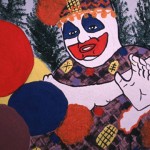
Bring in the Clowns: The Nefarious Paintings of John Wayne Gacy
by lissaredshoes
What sort of monster wears a clown suit and keeps the bodies of teenage boys in the crawl space of his home? Throughout history, humans have grappled with the question of what drives a person to acts of unspeakable evil. We want to know, because despite their evil acts, serial killers hide amongst us in plain sight. No matter the number of victims, or their sinister game, the killers hold jobs, shop for groceries, hang out at local pubs or entertain our children, sometimes as a clown.
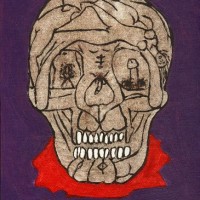
Sex Skull
John Wayne Gacy was married, managed three Kentucky Fried Chicken outlets in Iowa, and was the vice-president of the United States Junior Chamber, a civic organization that focused on community service and developing business skills. He later owned a construction company, hosted neighbourhood parties, and was a member of the “Jolly Joker” clown club, where he would dress up as a clown, perform at local charity events, and voluntarily visit sick kids at the local hospital.
To the horror of those around him, this “upstanding citizen” raped and murdered thirty-three teenage boys and young men within a span of six years, burying twenty-six of them in the crawl space of his home right under his neighbours’ noses. For most of his Summerdale neighbours, the mere mention of his name arouses conflicting emotions:
“What he did was carefully, thoroughly planned, John Gacy is Satan.”
“He slept for six years in that house with all those people buried there? That’s not normal. That’s insane.”
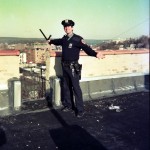
Pogo in the Making
An investigation culminated in Gacy’s capture in 1978, conviction and execution in 1994. After his capture, he became the “Killer Clown,” a nifty moniker that seemed to exemplify the unexpected revelation that he was a serial killer. Strangely, Gacy seemed to revel in his clown persona. Part of the serial killer’s method is façade, the ability to live an apparently normal life between, and in spite of, his accumulating murderous episodes. Gacy’s clown persona brought an almost theatrical element to his brutal acts – an image that he continued to exploit while in prison.
In May 2011, the Arts Factory opened an exhibition with 75 Gacy works to sell for between $2,000 and $12,000 apiece. The proceeds from the exhibit, “according to the wishes of the executor of Gacy’s art portfolio,” were to go to “the community at large, including the Contemporary Arts Center, 18b Arts District and the National Center for Victims of Crime.” However, as CNN reported at the time, the National Center for Victims of Crime refused any of the proceeds, sending a cease-and-desist letter to the gallery owner, Westly Myles.
Curse of the Clown Artist
During his 14-years on death row, Gacy took up oil painting using his favorite pet subject: himself, as Pogo the Clown. He said he used his clown act as an alter ego, saying once quite sardonically that, “A clown can get away with murder.” Particularly terrifying is that Gacy, a man already convicted of sexual assault, gained access to children in his guise as an innocuous clown. This highly publicized killer fueled America’s already growing fears of “stranger danger” and sexual predation on children, and made clowns a real object of fear and suspicion.
 The clown’s art is rather terrifying and full of anxiety and apprehension; their suicidal feats, monstrous gestures and frenzied mimicry remind us of the stage of a lunatic asylum. Clowns are unsettling—and a great source for drama. In America, the heyday of clowns corresponds with the television age with child entertainers like Howdy Doody’s silent partner, Clarabell the Clown, and Bozo the Clown.
The public outcry against Gacy’s art is tantamount to a belief that his paintings are evil talismans. But are they? Should art not be valued for its aesthetic appeal and contribution to the cultural landscape rather than on the morality of its creator? Does the rule “once a serial killer, always a serial killer” mean that Gacy’s paintings are not legitimate cultural objects worthy of study or collecting? The great painter, Caravaggio, was a murderer; Picasso was a wife beater; Francis Bacon was a thief and a prostitute; and the filmmaker, Roman Polanski, possibly a hebephile.
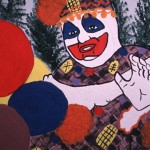
Pogo the Clown
However, the inherent evil and creepiness of Gacy’s art cannot be ignored. In 2001, singer Nikki Stone’s penchant for collecting ‘murderabilia’ took a morbid turn after purchasing “Pogo the Clown” for $3,000 from Arthur Rosenblatt. Afterwards, his beloved dog died and his mother found out she had cancer. Were these tragic events just a coincidence? Maybe not, but when a friend stored the painting at his house, the friend’s neighbour suddenly died in a car crash. A second friend who agreed to keep the painting attempted suicide. Oddly, actor Johnny Depp also invested in a Gacy clown painting, and reportedly became so freaked out that he developed a pathological fear of clowns and unloaded the artwork.
Profiling ‘Pogo the Clown’
Part of the appeal (or repulsion) of Gacy’s clowns are their ghoulishness — people have always been intrigued by violence and death. Just consider the popularity of shows like Criminal Minds, Dexter, The Following and Hannibal. Part of this fascination with “criminal artwork” also stems from a belief that it will help us better understand the twisted mind of a serial killer. Everyone likes to play amateur psychologist — so, what can we glean from Ramirez’ freaky devil faces or Gacy’s sinister clowns? Sociopaths or narcissists have a need for attention. They are also manipulative, and in the case of Gacy, duplicitous as hell.
Gacy’s clown portraits are primitive and creepy. His paintings are not masterpieces by any stretch, but do fit within the rubric of “Outsider Art.” I find his clown faces chilling to the bone yet eerily disarming. Possibly my reaction is pure fantasy and projection. The interpretation of art can be subjective, yet most paintings offer clues that help us to piece together a story.

Hi Ho With Clown
In “Hi Ho with Clown,” we see a flat and ghostly rendition of Pogo the Clown surrounded by the Seven Dwarfs. In contrast to their sculptural and animated faces, Gacy’s face is a flattened caricature — void of dimension or emotion, and accented with a black hole that enters his head and escapes into the background of a dark forest. Was it merely a Freudian slip to adorn himself in a frilly white suit laced with red? Or did he inhabit the role of Snow White in an attempt to reconcile a love/hate relationship with his sexuality? It is also peculiar that in many of Gacy’s clown paintings, you can see his hand seemingly severed from the rest of his body. Is it just the awkward skills of a naïve painter or is it a sign of his disassociation and a lack of remorse for assaulting and killing victims with his monstrous acts?
The idea that serial killer art can infect people with its evil miasma is an absurdity that may still hold a grain of truth. Although a painting cannot murder, it can have a profound effect on our psyches. A work of art is not a free or perverse agent acting in the world. It’s what we project onto an artwork that gives it power. Although Gacy’s canvases may be soaked in the blood of his victims (at least figuratively), should we really prohibit the exhibiting or selling of his art?
Burning of the Clowns
Some people have actually bought Gacy’s paintings specifically to destroy them. A bonfire in Naperville, Illinois in June 1994 was attended by 300 people, including family members of nine victims who watched 25 of his paintings burn to ash. While it can be seen as disturbing that people have paid $200,000 for a Gacy painting, the reasons one might desire to own his art are multifaceted. The motivation might be greed. For others it might be an aesthetic appeal or the morbid allure of owning a painting made by the “bloody” hands of an “iconic” killer clown. It might also be for the purposes of using the images to study the psychological profile of a serial killer. Are some of the reasons legitimate, and others not?

Handprint and Clowns
Haunted by Gacy’s own horrendous acts, his nefarious clowns have seeped into our collective conscience. It is difficult to say whether Gacy is the cause of clown phobias or that his sinister caricatures influenced the popularity of scary clowns like It, Krusty the Clown or Heath Ledger’s version of The Joker. What clown phobias really come down to is fear of the person under the make-up – and a savage but “seemingly caring” serial killer dressed up as a clown epitomizes that fear.
While I won’t argue that concerns about victims’ feelings are irrelevant to the marketing of Gacy’s art, I do think the calls for censorship are misguided. The Gacy clown painting controversy highlights the difference between the idea of art as a sacred object or art as an evil talisman. Yet, art is inevitably a window into the human soul or psyche. Is it possible that instead of evil lurking in the paintings of John Wayne Gacy, that our morbid fascination is merely a function of our human compulsion to project fantasies and fears onto these inanimate yet curiously evocative objects?
Click below to view lissaredshoes’ previous posts.
Stalking Is Not a Love Song (Unless You’re Sting)
Sex Police and Other Sordid Tales: Censorship and the Criminalization of Art in Canada
The Deathly Siluetas of Ana Mendieta
 lissaredshoes is a visual artist and writer living in Canada who writes about art and the criminal justice system with a special focus on wrongful convictions and the role media and arts play in contemporary culture. She runs her own blog, My Spotted Couch, a website for her visual art, and writes occasionally for Galleries West.http://spottedcouch.wordpress.com/
If you enjoyed this article, please consider sharing it!


Very interesting piece, Lissa. You brought up some great questions about how art by convicts should be perceived and issues around marketing.
My response was more a reflection on what the art represented for Gacy himself. Was this a form of art therapy for him, where he expressed his deepest conflicts on canvas? You hinted at this with reference to his sexuality. Certainly music therapy, with the right instruments and given a structured context that allows for ample improvisation is a very constructive way of channeling aggression in certain populations. Is it possible that had Gacy discovered painting early in life that he might have deflected his disturbing inclinations into something aesthetically and emotionally satisfying for himself, as well as interesting to others? It is worth reflecting on how the same art would have been received had he produced it as a secret catharsis, about which no-one would necessarily have been aware, rather than after the fact, with all the now unavoidable gruesome associations.
I am also reminded of Rodney Alcala’s photography which, removed from its associations with the girls he murdered, is often quite captivating. He implied himself at one point that it was a form of sublimation of his darker thoughts, and again I wonder whether had he found an opportunity to direct it in a more publicly open, artistic context, rather than as a covert way of exploiting young people, if his psychopathology might have taken a different direction.
Are there any cases of artists’ work (apart from children) revealing their psychopathology to the extent of triggering intervention, either self-initiated or on the advice of someone profoundly alarmed by their art?
I agree that any art by a “monster” should be preserved for examination and reflection on what it reveals about the artist’s psyche. Perhaps for this reason there is something to be said for originals not being available for ownership by the general public – it makes it too vulnerable to destruction, and in destroying such art we might be eliminating the only clues we have to what motivated horrendous acts. Art is itself a form of “forensic” evidence.
This is quite captivating in more ways than one. The sight of this man dressed as a clown always gave me the chills. I am not a big clown fan to begin with, but it totally spoiled it for me.
Interesting to think that Dr. Morrison kept Gacy’s brain and saw no abnormalities. When you think that he had a blood clot for years and would pass out constantly, it makes you wonder.
But Pitch is on to something with preserving his art for examination.
Also fascinated by what happened to some of the people who owned his paintings. I believe in human imprint on objects, so I would not risk it myself. The fascination is not great enough.
Hi Ho to kidnap and kill I go!
All of the points that are made here are very valid. What I am struck by, which people may have referenced, is the curious, and perhaps symbiotic, relationship between art — making/doing art — and the destructive impulse. It’s certainly something I’ve always been aware of in myself — especially when I was younger. If not “doing art”, I would more than likely be busily (and mostly unknowingly) employed in destruction of one kind or another.
I suspect a killer like Gacy felt that strongly, but if you examine his pre-art phase (the killing phase), look what he’s doing — the most banal tasks imaginable. Running KFCs, serving in the Junior Chamber of Commerce or whatever it was, dressing up like a clown. Not very fulfilling, perhaps? I would posit that it was only much later in life, when he began painting, that he — to whatever degree possible — transfigured himself into an artist. The question is: did the murderous impulse subside when he started painting, if not completely at least to the point where it was muted, or was it merely a replacement for the murderous impulse, the best he could do to approximate it because he was locked up and couldn’t get his hands on the adolescent boys, and thus the murderous impulse would come through subtly in the paintings?
A very good question, Patrick. I’m not sure that one can “rehabilitate” a serial killer, but I think their deviant thoughts can be channelled into something more productive like art. Even a very practised artist can reveal something of themselves in their work, why not Gacy?
Pitch and Lise,
Chilling to the bone, these works of Gacy’s, but I can’t help but find them enthralling. I think they are quite good for a naive artist, and I do believe the more I consider their content, the more the revealing they become of Gacy’s twisted mind.
I wanted to include a discussion of The Living Museum, but the article was already long enough. It is an art studio dedicated to presenting the art produced by patients at the Creedmoor Psychiatric Center, the largest state psychiatric care institution in New York City. The founders were two scholars, Bolek Greczynki and Janos Marton, who sought asylum in the United States, at Columbia University’s School of Visual Arts in the early 1970s.
A fantastic documentary was done by Jessica Yu — I highly recommend watching it. And if both of you are interested, we should plan to meet in NY someday to visit the studio! It was originally televised on HBO and I think it can be rented educationally. http://nymag.com/nymetro/arts/tv/reviews/228/
I think that Dr. Janos Marton is really on to something with his art project for the psychiatric patients. I’ve often wondered what would happen if programs like this were put into practice in our prisons.
And Pitch, as creepy as it is, I agree with you about Rodney Alcala’s photography.
I don’t know if either of you know about Yayoi Kusama art, but it’s absolutely incredible (and obsessive). She has a very interesting story. http://bombsite.com/issues/66/articles/2192
Fascinating post all around, Lissa. And thanks for this additional info on Living Museum, etc.
It is a good question, with regard any artist who demonstrates destructive tendencies, to what extent their art represents a replacement or sublimation of those urges, and to what extent the artistic expression itself protects society from what might have been had said artist not channeled his/her impulses into creativity.
In my youth I was a music therapist, and worked with many different populations, including psychiatric patients, and I certainly saw how through music people can tap into parts of themselves that in ordinary life do not, and perhaps even cannot surface. To cite a relatively banal example, It is well-known that many people who stutter in speech can sing fluently and without verbal hesitation because the part of the brain that processes musical rhythm is different from that directly associated with speech, so that certain speech impediments are over-ridden when the “musical” brain is activated. I bet there is research somewhere out there looking at the parts of the brain that deal with destructive impulses and how they relate to artistic processes – if not, there should be.
I never got round to doing music therapy with prison populations, but it was certainly something I was interested in. I would be interested to know how many correctional facilities in the US employ the arts as therapy with inmates, and I mean with trained arts therapists actively employing therapeutic techniques, not simply as a recreational activity with visiting artists/musicians, though that is not to say that arts activities that are not under the guidance of a therapist cannot be “therapeutic” to some extent. Was Gacy’s art done under the supervision of an art therapist or was he simply provided with oils and canvas without reference to a skilled professional who would explore it with him during and after his creative activity??
As far as I know, Gacy had no art therapist — nor any kind of therapist whatsoever. He was sitting on death row, a lost cause, a man seemingly incapable of remorse or empathy, so deep was his psychosis. The same lack of affect, or flattening, comes across in the clown paintings. In fact one can see how these paintings are so disturbing precisely because there is no movement at all toward therapy or healing. No issues are worked out. There is no hope. The paintings are simply a window directly into Gacy’s criminally insane mind.
Supposedly, Gacy’s last words prior to his execution were “Kiss my ass.” I see the paintings as a visual equivalent of this statement, sort of a F— You to the world. Almost like punk rock nihilism.
But that’s just my take on it.
I quite agree with Nashe on his assessment of Gacy’s paintings. There is no show of remorse or healing in any of the portrait paintings I have looked at. Hallmark narcissistic and sadistic, and his paintings, at least to me, are “flat” as Nashe says, but they also show a lot of disassociation from his sadistic self — in fact, he does seem to revel in it within his art rather than using it as a tool of transformation.
Gacy is a dark reveler and he is knowingly of the Devil’s party.
And had he had a therapist overseeing his creative output, he might, just might have been nudged towards ruminating in a different fashion and delving for other, repressed emotions…… We will never know, but that is what the current system of extermination without exploration prevents from happening, and in turn contributes absolutely nothing towards prevention in others….
Pitchforks, we are on the same wavelength. I was reading something earlier today that had an art therapist in prison discussing the idea that artists are not that dissimilar to criminals — interesting indeed.
But I also just found this very recent article on art therapy in prisons.
http://www.huffingtonpost.com/david-vognar/prison-art-is-taking-off_b_4368876.html
I wonder if art therapy is even considered for someone on death row since they are essentially biding their time until their execution. I do believe that art has the ability to transform (or at least direct energy towards something productive rather than destructive), and I wonder what we could learn from people like Gacy, as you say, rather than just giving them the needle.