

Stalking Is Not a Love Song (Unless You’re Sting)
by lissaredshoes
“Every breath you take
And every move you make
Every bond you break, every step you take
I’ll be watching you”
Sting’s breathy tribute to unrequited love or Stalking as we know it today. Sting wrote the song in 1983 when he was divorcing his wife. It won ‘Song of the Year’, ranked 84th on the Rolling Stone list of 500 Greatest Songs of All Time, and became one of The Police’s signature (and most misinterpreted) songs.
Sting has said on numerous occasions that although it sounds like a romantic love song, it is really quite sinister. In a 1983 interview with the New Musical Express, Sting explained: “I think it’s a nasty little song, really rather evil. It’s about jealousy and surveillance and ownership.” Regarding the common misinterpretation of the song, “On one level, it’s a nice long song with the classic relative minor chords, and underneath there’s this distasteful character talking about watching every move.”
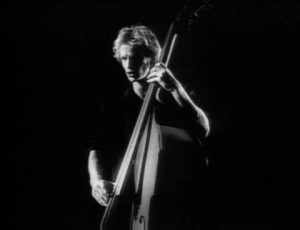
Sting
Such a ‘counter-intuitive’ response to Sting’s song may not be that surprising. In a recent paper by Nidhya Logeswaran and Joydeep Bhattacharya of the University of London, the duo’s research shows that music affects how we see visual images. The behavioural data clearly showed that listening to musical excerpts significantly influenced the participant’s subsequent response to visual emotional stimuli. The research may provide some unintended insight into why popular musicians can evoke such extreme responses in their audiences (hysterical crying or screaming, groupie devotion or even stalking). Were it only music, much of this behaviour would likely not occur. Celebrity culture and public persona by way of modern mass marketing (concerts, music videos, TV performances, interviews) has brought both a visual element and a human face to popular music.
Stalking is the willful following and repeated harassing of another person. Paul Mullen, Michele Pathé and Rosemary Purcell (1999) developed five categories of stalkers based on motivations and contexts: intimacy seekers, the incompetent, the rejected, the resentful and predatory stalkers. Surprisingly, most stalkers do not suffer from hallucinations or delusions. However, many do suffer from isolation and other forms of mental illness including depression, substance abuse and personality disorders.
The stalker may also focus on a celebrity, especially if they have seen him or her in person — at a public appearance like a concert. They develop obsessive or convoluted thoughts about the celebrity, feeling like he or she is the answer to their dreams or feelings of loneliness. Under this spotlight, the idiom “life imitates art” takes on new meaning for celebrity songbirds who sing of unrequited love and obsession.
Break-In at Tiffany’s
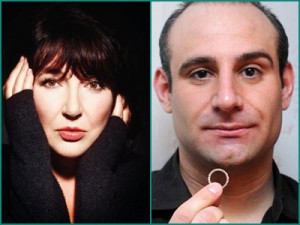
Kate Bush and Frank Tufaro
Kate Bush is quite reclusive. She lives in an isolated mansion atop a 100-foot cliff in Britain. However, this obstacle did not keep Frank Tufaro from flying halfway around the world to propose to her. In a bizarre attempt to win her heart, the obsessive fan broke into her house carrying a $4,500 diamond, sapphire and gold engagement ring he bought from Tiffany’s. Finding no one at home, he left in a panic shortly afterwards but was spotted by Bush’s neighbours, who called the police. In an interview, the 32-year old said that he had been infatuated with Bush since he was a teenager after watching her in an advertisement. He found his way to the singer’s home using satellite co-ordinates downloaded from the internet. The heart-stricken Tufaro, who was arrested, detained and deported under the Mental Health Act, had this to say:
“I feel so connected to her. I feel so much love for her and I want to protect her.”
Tufaro definitely fits the profile of an “incompetent” stalker. This person is socially backward and does not really understand the social rules involved in dating and romance. Typically, this type of stalker does not mean any harm.
Possession
When obsessed fan, Uwe Vandrei sent Sarah McLachlan an excess of love letters over two years, instead of recoiling in terror, she penned a song. “Writing the song ‘Possession’ was very therapeutic,” the Canadian singer told Rolling Stone. In a bizarre twist, Vandrei launched a lawsuit against McLachlan, for $250,000, claiming she used his poems as the basis for Possession.
 Oh Sarah,
Will I ever hold you on that shore?
Or only live it in a dream?
Will I ever tell you of my fears?
Will you ever collect my tear?
Uwe Vandrei
Letters to Sarah, 1992
And I would be the one to hold you down,
Kiss you so hard.
I’ll take your breath away
And after I wipe away your tears
Just close your eyes dear.
Sarah McLachlan
“Possession,” 1994
So desperate was he for McLachlan’s attention that he thought nothing of exposing his obsession to public scrutiny. After going public with the lawsuit, he sent copies of his letters to CKCU radio. One American detective described this behaviour as rather unsurprising. For an obsessed fan like Vandrei, going to court would be like going on a date. He would get to be in the same room as her, talk to her, admire her and learn new details about her life. Rodney Murphy, a Carleton University student who spent several hours talking to Vandrei at a McLachlan concert in 1993 had this to say:
“The court case wasn’t about money. He didn’t need it. He was very well off. All he wanted to do was meet her. He was in love with her music, her whole persona.”
Tragically, on September 28, 1994, Vandrei committed suicide before the case went to trial.
Vandrei fits the profile of the “intimacy-seeking” stalker. They become infatuated with a person he or she perceives as their one true love, and are often delusional as they focus on pursuing an intimate relationship. Often they focus on someone of higher social status. This person is mentally ill and delusional.
All these years your music kept me warm in that winter. You warm me so, and we have not even met yet!
– U. Vandrei
Letters to Sarah, 1992
While celebrity stalking makes the news, far more frequently, many women (and men) are at risk of becoming victims of stalking – typically by someone they know.
The Black Swan
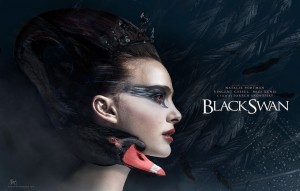 In the Black Swan, the character of Nina lives the emotional life and physical life of a child, dependent on her mother for care. Nina’s mother treats Nina as a child. She is not capable of functioning as an adult. Enter stage left, a 21-year old musical theatre student who recently obtained a stalking restraining order against her parents.
Aubrey Ireland is a gifted theatre major who regularly fills lead roles at Cincinnati’s prestigious College-Conservatory of Music and has made the Dean’s List every quarter. Her complaints began when she realized that her parents had installed monitoring software on her computer and her phone. They paid unannounced visits by traveling 600 miles from their home in Kansas, to meet with Aubrey’s department head and to accuse her of promiscuity, of using drugs and of having mental issues.
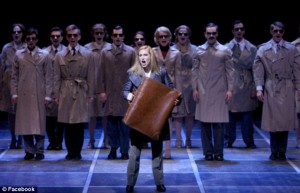
Aubrey Ireland performing
As her situation escalated, the young Ireland called police to her apartment, claiming that her mother assaulted her, who in turn claimed that her daughter had assaulted her. Allegedly, the university hired security guards to keep her parents out of her shows. When she cut off all contact with her parents, they stopped paying her tuition and demanded she return the $66,000 they had spent. The judge refused and the college gave her a full scholarship for her final year. In the court hearing, Ms. Ireland stated:
“It’s just been really embarrassing and upsetting to have my parents come to my university when I’m a grown adult and just basically slander my name and follow me around.”
David and Julie Ireland were ordered not have contact with their 21-year-old daughter and to keep 500 feet away from her at all times. Although Black Swan is fiction, it nevertheless explores hidden realities of high-stakes art and performance. For now, Ms. Ireland seems to have escaped the smothering wrath of her obsessively controlling stage parents. Interestingly, her parent’s type of stalking doesn’t fit into the typology outlined by Mullen et all.
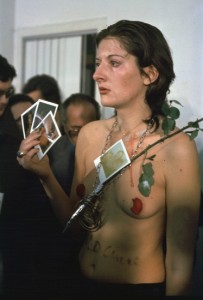
Marina Abramović, “Rhythm 0,” 1974
Although our society is quick to condemn stalking, a voyeuristic act taken too far can be intoxicatingly provocative – and dangerous. Just ask the performance artist, Marina Abramovic, whose art often reveals the dark corners of our masochistic desires.
In Rhythm O, one of her bravest performances, the artist offers herself to the audience by allowing members to use an array of 72 objects – condoms, a feather, razor blades, matches, flowers and a gun with a bullet in it – on her body. Over the 6-hour performance, the audience becomes more and more aggressive towards her, leaving her injured and violated, with one man holding a gun to her head for two hours. After unabashedly placing their desires onto her passive and inert body through physical violations, many of them moved away in fear of retaliation once she cut off the performance and moved towards them.
Elegantly played, Abramovic reverses the roles by turning the stalkers into the stalked. Much like the artist, the cult of celebrity confronts us with compelling images that are intoxicating and call to us like sirens – often reaching into, and locking onto, our most primitive desires.
Click below to view lissaredshoes’ previous posts.
Sex Police and Other Sordid Tales: Censorship and the Criminalization of Art in Canada
The Deathly Siluetas of Ana Mendieta
 lissaredshoes is a visual artist and writer living in Canada who writes about art and the criminal justice system with a special focus on wrongful convictions and the role media and arts play in contemporary culture. She runs her own blog, My Spotted Couch, a website for her visual art, and writes occasionally for Galleries West.http://spottedcouch.wordpress.com/
If you enjoyed this article, please consider sharing it!


So interesting! Stalking is a manifestation of so many different human emotions and I like your take on these specific cases. So creative.
In the world of celebrities and the arts, what fascinates me is that the sirens are singing and enticing. Their songs are heard loud and clear by the ones sensible to that sound.
I’m not sure what I’ve created here, Lise, but it was an interesting article to write. It was definitely an exploratory piece. Thank you for reading!
Fascinating topic. I’ve always thought Every Breath You Take was kind of a creepy song. Weird how so many people think of it as a song of love and devotion.
It’s odd how society tends to glamorize stalking behavior – until it becomes violent. The Shades of Grey fiction series is one example of glamorized stalking. I was given the first book in the series as a gift, and decided to try to read it. (I only managed to read part and skim most.) The lead male that so many women are swooning over is a disturbed stalker who shows his love by treating her like a possession. I don’t understand how this stalker-character became the hero turning women on, but it says a lot about our misunderstanding of what love really is.
Darcia, great comments. I completely agree with you about 50 Shades of Grey. The male character is a completely controlling jerk off, but I hadn’t thought of him as a stalker until you brought it up! I think people like the idea of being stalked (attention) until it turns violent as you say. Abramovic’s piece really highlights how many of us do have the potential to violate others when given the chance. Makes it all rather human and creepy, doesn’t it?
I think “Every Breath You Take” is NSA Director Keith Alexander’s favorite song.
Enjoyed reading this. The stalking examples are creepy. The parents stalking their daughter are especially round the bend. That’s a twist I hadn’t heard before.
I wonder if Marina Abramovic was worried that the “audience” might end up killing her. Or if the audience members spent the next few weeks looking over their shoulder, afraid of who might be following them. Maybe some of them went insane after that performance.
Nashe, I have a feeling that they may have been genuinely afraid. Some apparently didn’t just back up, but left the space immediately. She’s controversial, but I admire her greatly as an artist. I thought this piece had some echo to that prisoner experiment they did with students. Remember that one?