
Dead Body at the Crime Scene – What Forensic Value Does It Have?
by John Palucci
I would like to shed some light on one particular question that has attracted a lot of attention in Ferguson, MO; why was the body at the crime scene for so long?
Looking at it from a forensic perspective, the position of the body and its spatial relationship to the other evidence in the crime scene is essential to reconstruct the events that transpired. I am avoiding the use of names intentionally to depersonalize this as much as possible.
What initially caught my attention and did suggest negligence was the excessive delay in the response time of investigative personnel to the crime scene. I have read quotes from Ferguson PD personnel which state that this was due to the amount of unrest that was taking place, and that once on the scene, investigative personnel were unable to begin their investigation promptly because they were being deployed for crowd control.
 Understandably, the body being exposed to the public is one direct cause of this unrest and with today’s technology and “forensic awareness”, that situation should have been remedied properly and as expeditiously as possible.
Forensic supply companies sell pop up tents and barriers designed to shield a body from public view and weather. Also, single use covers that are specifically manufactured to be free of contaminants can be placed over a body and later examined for any transfer of trace evidence.
If these items were not available, a more difficult procedure would be to expand the boundaries of the crime scene. It can be argued that the initial boundaries should have been established far enough up the side streets so that the building line would provide cover – although there were many windows facing the scene.
 I cringed when I saw the video of a police officer walking towards the body with a sheet of unknown origin, not packaged, and blowing against his uniform in the breeze. Uniform fibers on the subject’s clothing are highly probative and as a result of this carelessness, it could be claimed that any blue uniform fibers on the subject were not from a struggle, but were rather the result of secondary transfer from the police officer to the sheet to the subject. What happened in Ferguson is another case supporting more comprehensive training of first responders in crime scenes who will be handling forensic evidence!
In a New York Times article titled “Timeline for a Body: 4 Hours in the Middle of a Ferguson Street”, that quoted both myself and Dr. Michael Baden, Dr. Baden mentioned the ambient heat as a factor that would command strict attention being paid to minimizing the amount of time the body was left on the scene. From his perspective as a forensic pathologist, heat accelerates the decomposition of a body, thereby making his already difficult task of autopsying the body even more painstaking if the body is left at the crime scene for too long.
 Any delays in the response of a crime scene unit to a crime scene is rarely the investigators’ fault since teams are dispatched under the authority of a supervisor, who is often an executive level manager in high profile cases. It’s important to understand that once the investigators do arrive, processing a crime scene is methodical and time consuming. The location of the body in relation to other evidence has to be documented with photographs, measurements and a sketch. These details are of the utmost importance when it comes to evaluating the credibility of statements made by witnesses and subject officers.
In this case, the body’s position as it relates to the shell casings would have a significant impact on reconstruction. Shell casings found at a crime scene don’t reveal the shooter’s exact position as the CSI dramas would have you believe.
Firearms don’t eject casings consistently enough to use their location as a precise metric in determining shooter position, and casings are often kicked, moved, blown around and run over before a scene is secured. In the Ferguson matter, the street was secured immediately after the shooting so the integrity of the shell casings’ position was properly maintained by the Ferguson PD.
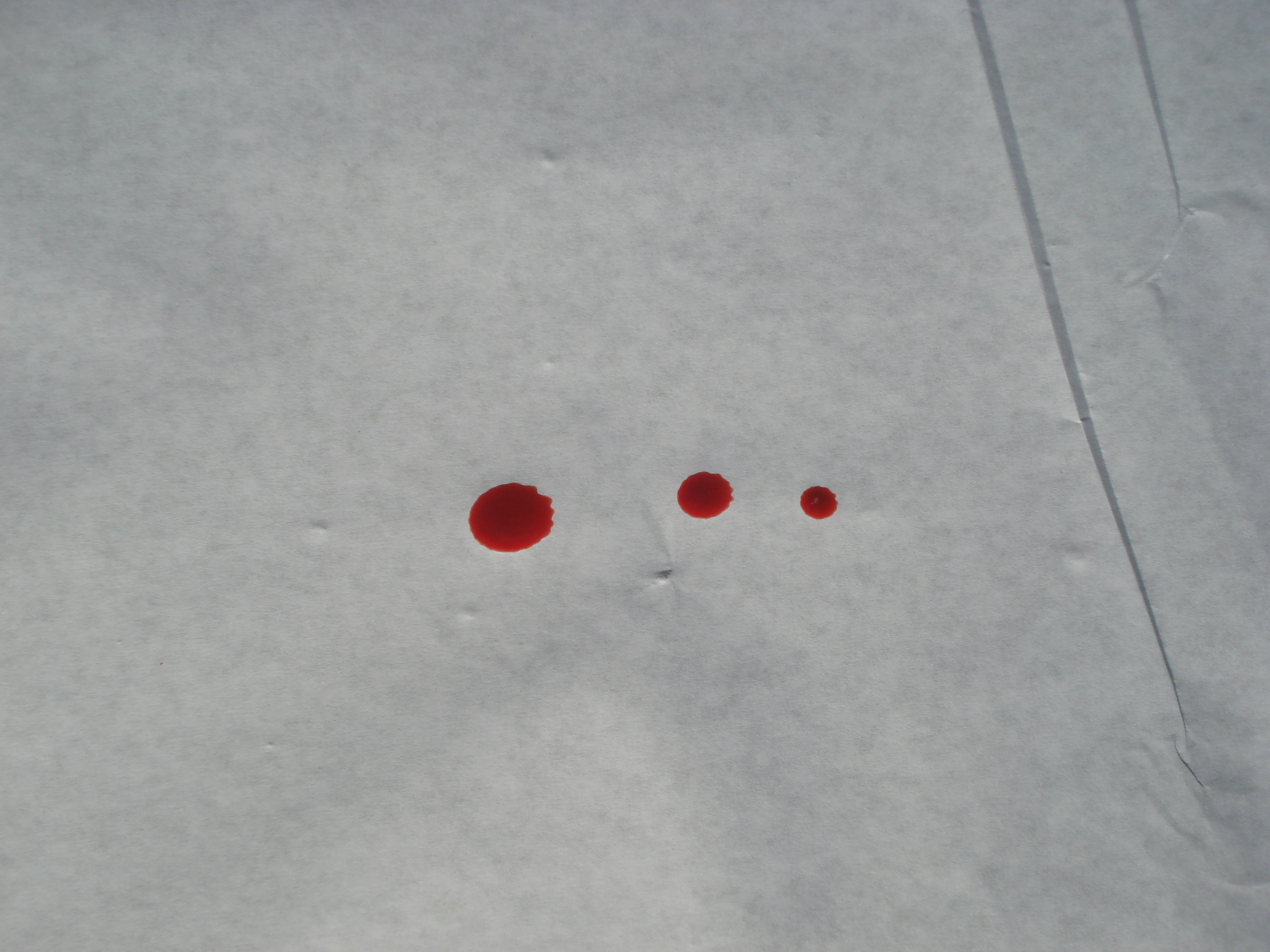 Another forensic discipline that plays an important role in reconstructing the events of this incident is bloodstain pattern analysis. Since the subject was bleeding throughout most of his movements between the police car and his final location, the bloodstains provide crucial information as to which direction(s) the subject was traveling.
When a bleeding subject is in motion, the bloodstains deposited on the ground will show the direction of travel. The area where the directionality of the bloodstains is most crucial would be in the vicinity of the body. Did the subject reverse direction and charge back in the subject officer’s direction? The “drip trail” can answer that.
 Bloodstains from the drip trail should be sampled for presumptive testing and DNA analysis throughout the drip trail to verify, first of all, that the stains are blood, and that it was the subject who deposited the bloodstains, which would supersede any future claims that the stains were someone else’s blood deposited at a different time.
To remove the body prior to the crime scene unit’s arrival would have jeopardized any analysis of these highly probative bloodstains. A body of that size has a large volume of blood. Morgue personnel would not be able to move such a large body without altering existing bloodstains near the body and also depositing additional bloodstains as blood still in the vascular system found its way out of the wounds, which were downward facing.
 Every effort should have been made to expedite investigators’ response to the scene. Timely removal of the body was important due to both the weather and the civil unrest, but once on the scene, it must be remembered that the investigators have far more work to do than simply snapping a few pictures.
There is only one opportunity to document a crime scene with photos and sketches before valuable evidence is lost, contaminated and/or altered. This case will be examined and scrutinized for years to come, which only increases the need for thorough and precise documentation.
 About the Author: John Paolucci is a retired Detective Sergeant from NYPD. He worked in the New York City Housing Police in the South Bronx for four years and undercover in Harlem for another three years. After being promoted to Detective Sergeant, he spent his last eight years on the force in the Forensic Investigations Division, four of them as a Crime Scene Unit supervisor. He was the first ever to command the OCME Liaison Unit where he managed all DNA evidence in NYC and trained thousands of investigators in DNA evidence collection and documentation. He developed a strong alliance between the OCME Forensic Biology Department and NYPD. John is currently the president of Forensics 4 Real Inc., where he provides forensic support to private investigations, international and domestic. He also trains students and law enforcement in forensic evidence and crime scene investigations and provides consultations with movie and television writers, directors and developers working on real crime shows and dramas. www.forensics4real.com.
Click here to view Officer Paolucci’s earlier posts:
Forensic Dispatch From New York City: Searching a House of Horror
New York City Housing Police: A Bygone Era Worth Talking About
If you enjoyed this article, please consider sharing it!







Excellent article! Viewers of crime shows like Castle and Rizzoli & Isles have inadvertently been taught that bodies are taken away immediately after the homicide detectives wave their hands in dismissal. Thanks for the clarification.
Hi Darcia. Thanks so much for your input and insight. There’s a lot of things that happen on TV that have nothing to do with real life, but unfortunately the myths create unrest in these situations and also taints jurors all over the country. Hopefully some understanding of how complex and sensitive these investigations are will start to bring the crime drama enthusiasts back to earth.
Thanks for your excellent and illuminating post, John! Your insights help to dispel some of the myths about the processing of crimes scenes perpetrated by shows like CSI.
It appears to me that the Ferguson PD was ill-equipped to handle a homicide investigation and that is one of the main reasons why it took so long for a forensic team to arrive at the scene. Do you agree with that assessment? Or, do think that it is more likely that the delay in dispatching a forensic team to the scene was due to systemic racism within the police department and/or a desire to protect one of their own who did the shooting in the hope that the passage of time would degrade the forensic evidence? In other words, did Michael Brown’s body lay in the baking Missouri sun for 4 hours due to the incompetence and negligence of the Ferguson P.D. or due to intentional misconduct of its officials?
From what I’ve read and heard, the Ferguson P.D. and the city government is a cesspool of racism. One of the primary sources of funding for the city’s operations is through fines levied on its residents. By one estimate, the average household in Ferguson has 3 outstanding warrants for the payment of fines each year averaging about $1,800.
Hi Rick. Thanks for reading this article. Ferguson PD, not unlike many other small town Police Departments, does not have a crime scene unit so the St. Louis PD crime scene unit had to be dispatched. For this to be a conspiracy you would have to have more than one agency involved, so I would be confident in dismissing any such theories.
I can tell you in my 20 years with NYPD I have seen many instances where race was blamed for a situation when in fact it played no role whatsoever. Google what happened in my rookie year – 1992 – when a white narcotics cop, Mike O’Keefe, shot a Dominican drug dealer, Kiko Garcia and two people who claimed to be witnesses lied about the incident (and were never prosecuted for it!).
Washington Heights nearly burned to the ground as the media blamed race and bashed the NYPD, inciting anger, fear and hatred. Detective O’Keefe’s life was destroyed by this. Innocent cops have taken their own lives because of the unrest from the vitriol the media puts out on an incident that at worst was the result of an accident. We need to be able to step back and recognize our emotions and impulses, evaluate them fairly, and see what facts support them.
I’m glad I have a pension because I like to write stories without taking a side, presenting facts rather than playing to the emotions of people who are already upset……this stuff I write really won’t sell newspapers but that’s not why I write it. By informing people, I give them the power to make their choices on a basis other than conjured up emotions. Whatever an informed person chooses is their choice and I don’t judge them for it; at least they’re informed.
I took a journalism class in the 80’s and the teacher gave us a scenario where a woman was in the hospital after escaping a fire in which her husband and children were killed. He said:
“Paolucci, where’s your story?” to which I replied,
“I’d talk to the fire chief and see what the cause was and how people can take precautions at home so this doesn’t happen to them.” He laughed at me and said,
“You’re washed up – you will never sell newspapers. Your story is at the hospital, interviewing the grieving widow and getting pictures of her anguish!”
This is how that business works. If you think it’s terrible, the only thing you can do is take personal responsibility and not support them and more important, not let yourself be sucked into this pattern of behavior that we’ve come to expect and actually accept as the “norm”. One person at a time can make this a better world Rick. As Gandhi said, “Be the change you want to see in the world.”
John – Thanks for your usual thoughtful comments. I agree with you that it is all too common for the “court of public opinion” to draw conclusions about cases based on often-inaccurate media reports. I’m sorry to hear about your former colleague whose life was ruined by an improper accusation. I also appreciate the Gandhi; he uttered many words to live by. 🙂
Thanks go to you Rick! Great sharing these thoughts with you.
Have you ever been asked to go through other cases where they put the cause of death as suicide and we all know it wasn’t. How do you get help when this happens and how often do you know it happens… Can you tell from the police report and autopsy what happened… How can you help a family when they stick together.
If you have a case like this, you need to find an attorney who is interested in taking the case on a contingency basis with the goal of proving what really happened. Often, if it can be proved that it was not a suicide or that law enforcement or some other agency used excessive force, the lawyer will file a civil suit against whoever is believed to be responsible for the individual’s wrongful death. So it’s basically a wrongful death suit. These are very common and many attorney’s handle them. The attorney will find investigators who will also work on a contingency basis to get to the bottom of what really happened. I hope this answers your question.
It’s generally easier to win a civil settlement than it is to get criminal charges filed against the offending party though this varies from case to case.
If a third party, not an agency, is wrongly responsible for the death, you can still win a civil settlement but it will likely be very hard to collect damages unless the perpetrator is well off.
Hi Cheryl. I’m actually working on a case where I’m examining the evidence to see if in fact it was a suicide right now! Patrick’s advice is right on the money. Get a good attorney, don’t talk about it to anyone and safeguard anything you plan to use to make your case.
[…] Dead Body at the Crime Scene – What Forensic Value Does It Have? […]
[…] Dead Body at the Crime Scene – What Forensic Value Does It Have? […]