
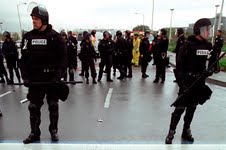
 Photographers, whether professionals or ordinary citizens with camera phones, are not usually criminals. So why are so many being arrested for taking pictures?
Carlos Miller is the chief author of the blog Photography is Not a Crime. Miller started his career as a police reporter, and worked at various newspapers, including the Las Cruces Sun-News, the San Bernardino Sun and the Arizona Republic. He returned to his hometown of Miami in 2004 to pursue independent journalism, and soon found himself in trouble with the local police. While roaming the city making a photographic record of the local scene, he was repeatedly told to put his camera away.
One night in Miami, while on assignment for a website, he refused an order to stop taking pictures. According to the Columbia Journalism Review: “He was arrested and charged with nine misdemeanors: five counts of refusing a lawful order (because there were five cops); disorderly conduct, obstructing justice, and resisting arrest without violence.”
Miller fought the charges. He was acquitted of everything but resisting arrest, and then acquitted of that upon appeal. He blogged about the case, and the blog became Photography is Not a Crime. It is now one of the most successful blogs in the Miami area, and posts a constant stream of stories describing police conduct towards photographers across the country. Arrests and the confiscations of cameras abound.
American police became concerned with being recorded after the Rodney King beating was videotaped in Los Angeles in 1991. The intensity of their concern increased when BART Police were recorded with multiple cameras at the Fruitvale Station in Oakland, California, killing an unarmed man named Oscar Grant. He was shot in the back on New Year’s Morning 2009, while lying on his stomach on the station platform, where he and some other passengers had been detained. The video of Grant’s killing was obtained by local television and replayed extensively, and the Bay Area public was shocked and aggrieved. The officer who shot Grant, Johannes Mehserle, is now on parole. Rodney King and Oscar Grant were African-American, raising age-old issues of racism in law enforcement.
In a 2012 case involving the New York Police, a photographer for the New York Times, Robert Stolarik, a ten-year regular with the paper, was photographing a developing street hassle when he was asked by a policeman to stop taking pictures. Stolarik, who was on assignment covering the NYPD’s controversial “stop-and-frisk” policy, identified himself as a professional and continued to work. Stolarik reported that a second cop appeared, took Stolarik’s camera, and slammed it into his face. The police department said in their official report that Stolarik struck a cop “inadvertently” with his camera. In any event, Stolarik was subsequently beaten by multiple officers, and the beating was recorded on video by a fellow reporter. Stolarik’s $20,000 worth of camera equipment was confiscated, and he went to a local hospital.
In a Times Intelligencer interview, Stolarik, who is 43, said, “I always try to be reasonable. But there’s going to be a next generation [of journalists] to come up, and if we accept this type of behavior, what happens to that next group of people?”
And, one might ask, what happens to the citizen journalist, who perhaps shoots with a cell phone, and who doesn’t have the backing of a powerful institution like the New York Times? For now, about all he or she can do is write a blog post on Carlos Miller’s page.
I recently had the chance to write the story of an Indymedia photographer, Bradley Stuart Allen, who was charged with trespass, vandalism and felony conspiracy for photographing the occupation of an abandoned bank building in Santa Cruz, California. At his preliminary hearing, the DA claimed he created “propaganda” for protesters who then trespassed, leading to vandalism. Allen faced paying thousands of dollars in restitution and spending years in jail. A photographer for the local mainstream newspaper, the Santa Cruz Sentinel, also covered the story and, of course, was not charged.
Journalists and civil liberties groups, including the ACLU, backed the Indymedia photographer. One leading Bay Area First Amendment attorney didn’t mince words in a recent tweet, calling the charges “unconstitutional bullshit.” The charges were eventually dismissed. However, Allen suffered “punishment by process,” as it cost him money, time and distress to defend himself.
I have photographed many police actions over the years. My impression was always that individual officers, who could be fickle, decided whether to allow photography as a First Amendment right or put a stop to it. Now, however, the stakes have been raised across the board.
Professional news photographers continue to want to photograph the “police at work.” Activist photographers want to photograph protest, where there is virtually always a strong police presence. The public wants to photograph everything, including police, and things police may not want them to photograph. And of course the lines can be blurred between these three categories.
Photography, as Carlos Miller says, is not a crime. It is, however, being punished as a pseudo-crime. There is a groundswell of police resistance to the practice of photography, and it may eventually be codified into state or federal law. However, as of now it is not law, just a rising tide of law enforcement opinion. It’s critical that photographers know their rights and insist that they are upheld.
posted by Peter Maiden on March 29, 2013
If you enjoyed this article, please consider sharing it!


3 Responses to Is Photography a Crime? A Pseudo-Crime? Something Is Wrong with This Picture
Leave a Reply
CRIME CLASSIC OF THE MONTH: THE SNOWMAN

AUTHORTALK: DEAD MAN’S HAND BY LUKE MURPHY
Read author Luke Murphy's account of his experience on the road from professional hockey player to successful author.

Great post. I was living in the Bay Area when Oscar Grant was killed, and I just happened to be in downtown Oakland on the afternoon that the verdict on Mehserle (the BART cop who shot Grant) was delivered. All businesses were shutting down. Protesters were gathering. An army of cops in riot gear was assembling. Most people were fleeing the area. I can just imagine how those cops would have treated anyone taking photographs once the action started. They didn’t appear to be in the mood to pose for pictures. Would take some cojones to be pointing a camera around in that context. Kudos to the brave photojournalists who refuse to be intimidated. Looking forward to visiting the Photography is Not a Crime Blog.
I did not know that photographers were being accused of resisting arrest and being a danger to the public. This is something is reminiscent of the censorship of the press like in the Soviet Union and other undemocratic states. Photography should not be punished because it is the public’s right to know what is going on in their community and our society.
As Americans we must fight these authoritarian measures by the police or else we risk becoming an undemocratic totalitarian fascist state.
You’re absolutely correct in everything you say. The problem is fighting a state which shows signs of sliding into totalitarianism is no easy task. Naturally, positive change should come through legislation, but when you have a right wing congress that’s not likely to happen. As the police state grows in strength, the “American way” become more and more an ideal, rather than a reality.