
‘Anonymous’ Leads Protest Against Albuquerque Police Violence
by BJW Nashe
No one should be surprised that police conduct in Albuquerque, New Mexico has resulted in angry protests by citizens on the streets and activists online. A recently released video that shows Albuquerque police fatally shooting a homeless man who was “camping illegally” has shocked and outraged viewers across the nation. You’d think Albuquerque city officials would realize that their police officers have been shooting at too many people during the past few years. For now, however, city leaders are patting themselves on the back for “dealing effectively” with the public disturbance caused by the controversy. Using riot cops and tear gas, they have managed to quell last weekend’s “mayhem” and thus “restore order.”
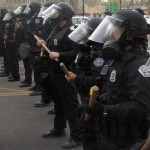
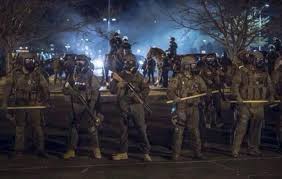
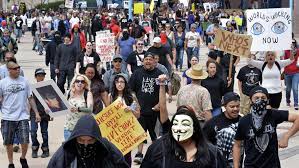 On Sunday, March 30, Albuquerque’s normally peaceful downtown streets were disrupted by hundreds of protesters carrying signs and chanting slogans, blocking traffic, breaking windows, clashing with police, and temporarily trapping officers in a surrounded squad car. Many in the crowd wore the stylized Guy Fawkes masks that serve as the public face of the “hacktivists” called Anonymous. Eventually, the crowd was dispersed by a small army of paramilitary storm troopers wielding clubs and firing gas canisters.
Meanwhile, as the action on the streets intensified, the Albuquerque Police Department’s (APD’s) website was temporarily shut down by a distributed denial of service (DDoS) attack. Phone numbers of APD personnel were hacked and released to the public. Anonymous, which has mounted similar high-profile attacks against other organizations, made it clear that they were targeting the city of Albuquerque for civil disobedience. Last week the group posted a video announcement on YouTube , declaring: “APD you now have the full attention of Anonymous… To the citizens of Albuquerque, it’s time to organize… Anonymous grab your cannons and aim them at Albuquerque police websites.” The “cannon” terminology here is a reference to the software used in DDoS attacks, which is called Low Orbit Ion Cannon.
 The reason for the public disturbance is simple. Since 2010, Albuquerque police have opened fire on suspects 37 times, resulting in 23 fatalities. For a jurisdiction of approximately 555,000 people, this is a high number of shooting incidents. The APD is currently the subject of a year-long investigation by the U.S. Department of Justice for complaints of civil rights violations and allegations of excessive use of force. Many people in the area are fed up with what they see as routine police violence.
The video of the March 16 shooting of James Boyd in the Sandia foothills near Albuquerque proved to be the tipping point for concerned citizens and activists. An NBC News report describes the incident in detail: [http://www.nbcnews.com/news/us-news/fatal-shooting-new-mexico-man-sparks-killer-cops-protest-n67931]
“A police officer’s lapel camera captured footage of the standoff around 7:30 p.m. that day. In the video, Boyd appeared agitated as at least four officers and a police dog closed in on him. At one point, he grabbed his belongings and told the officers he would go with them.
“Then, one of the officers lobbed a flash-bang grenade as a diversion.
“‘Get on the ground! Get on the ground now!’ the officers yelled at Boyd.
“Boyd appeared to turn around when an officer fired at him. Police claimed that Boyd, who was clutching knives when he was shot, had threatened them during the standoff. Police shot six live rounds as well as bean bags and stun guns.”
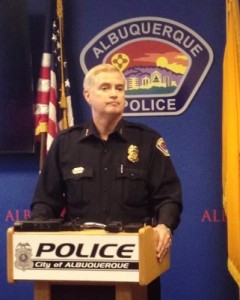 The disturbing video is a public relations nightmare for Albuquerque Police Chief Gordon Eden. Yet he has been quick to defend the actions of his officers. At a news conference held after the video’s release, Eden stated, “All of the less-than-lethal devices were in fact deployed. It was when the K9 officer was down directing the K9 dog that the suspect pulled out the two knives and directed a threat to the K9 officer who had no weapons drawn.”
Some will agree with the police chief that the use of force in this case was justified. They will point out that the suspect, James Boyd, had a history of mental instability, with numerous prior arrests for assault and disorderly conduct. They will argue that Boyd had previously threatened officers at this same illegal camp site.
For many of us, however, the incident raises a number of serious questions. Why were four or more heavily armed officers dispatched to deal with a man who was merely camping in an “unauthorized area?” Why did the officers have rifles aimed at Boyd, who was clearly distraught, and most likely suffering from mental illness? Why was so much firepower used to subdue him? Even if he did have a small knife in his hand, did he pose a significant threat to the officers who were standing 20-30 feet away from him? Why were shots fired into his back as he appeared to turn and flee? Why was the police dog allowed to gnaw on his lifeless body sprawled out on the ground?
The incident is an ugly reminder of the risks involved when American communities embrace heavy-handed law enforcement tactics as part of an overall tough-on-crime agenda. There is a price to be paid for “total security.” In New Mexico, as in many other U.S. states, many citizens are wondering whether the high price is worth it. At what point does a secure community turn into a police state?
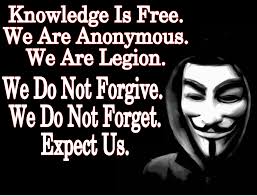 While the uproar over police violence is clearly a public relations disaster for Albuquerque city officials, the opposite seems to be true for the activists whose rallying cry online is delivered in a dry, electronically altered monotone: “We are Anonymous. We are legion. We do not forgive. We do not forget.” Since 2003, the people behind the Guy Fawkes masks have disrupted business-as-usual for several organizations — including the Church of Scientology, Visa, Mastercard, Paypal, the Westboro Baptist Church, numerous U.S. and foreign government agencies, and intelligence security firms such as HBGary and Stratfor. Anonymous also played a significant role facilitating the Arab Spring uprisings and the Occupy Wall Street movement. Many associates of the group — most notably Jeremy Hammond and Barrett Brown — have been arrested during a widespread government crackdown and charged with serious crimes. Their comrades and supporters view them as political prisoners, and refuse to wave the white flag of surrender. In fact, the group insists that its reach and impact will only grow over time, and inspire other groups to build on their example.
 The recent protest in Albuquerque demonstrates that the decentralized, digitally connected brand of online activism practiced by Anonymous remains a force to be reckoned with, and will most likely continue to play a significant role in politics and world affairs. Whether or not one agrees with all of Anonymous’s activities, and whether or not the group ultimately succeeds in its goals, it is important to understand that the group has found a unique political methodology that works locally and is linked globally in ways that were heretofore unimaginable. This ingenious model of activism will be receiving more, rather than less, attention in the future.
If you enjoyed this article, please consider sharing it!


I totally agree with nonviolent demonstrations against the violent tactics of the police.
But I prefer Gene Sharp’s methods. “People try nonviolence for a week, and when it ‘doesn’t work’ they go back to violence, which hasn’t worked for centuries.”
-Theodore Roszak
I think that it is a moral imperative to demonstrate without violence. I resent protesters who break windows, cars or any kind of property. It beats the purpose of the event.
But hell yes to the uprising
Yes, I agree. Typically protests like this start out as a peaceful marches. Then the riot cops show up. Tension mounts as the hours go by. When the cops eventually try to disperse the crowd to free up traffic, some in the crowd inevitably decide to fight back. Things can get ugly very fast. Usually the protesters bear the brunt of the violence. I understand the anger that leads people to throw rocks and bottles when police start in with the tear gas and the batons. During the Occupy Oakland protests, I remember feeling like the situation on the street was pretty calm during the daytime. With nightfall, you could sense a shift in the overall tone. Those of us who weren’t interested in fighting the police all night tended to go away. Many thought they had the right to assemble all night long, however. If denied that right, they were willing to light fires and smash windows and get beaten and arrested. Pretty heavy action, all around. The community largely supported the protesters, and figured the police were the ones who instigated the violence.
Brave souls like Edward Snowden and activist groups like Anonymous are among the last bulwarks of a total fascist takeover of the so-called democratic societies. Just look at what happened today in the Supreme Court in the McCutcheon decision, in which it abolished aggregate individual campaign contribution limits in an election cycle because, as we all know, money is speech. (I’m still unsuccessfully trying to teach the Washingtons, Lincolns, and Hamiltons in my wallet how to speak. . .). And three years ago, the Catholic phalangist Supreme Court handed down the infamous decision in Citizens United. The oligarchs have the people on the run and it’s now time for us to take our country back before it’s too late (and we may well have already crossed the Rubicon). We must post haste pass constitutional amendments which allow for public campaign financing and provide that “money is not speech” and that “corporations are not people.” http://www.stampstampede.org/
It’s time for the people to engage in civil disobedience, refuse to move, and refuse to work. A general strike of several days would bring the capitalists to their knees. Obviously, any protest must be peaceful, which is not to say that we should not attempt to break the gears of the machine and remake it more to our liking. A common problem with large demonstrations is that they often turn into police riots, after law enforcement harshly treats peaceful protesters (Chicago 1968), or agent provocateurs embedded in the crowd provoke the police into attacking the crowd (Chicago’s Haymarket Square 1880s).
I agree, Rick. The Citizens United decision, along with this follow-up ruling today, are two of the worst political developments in American history. These are brazen acts of class warfare that will have serious ramifications down the line. At some point (who knows when), we will reach a crisis point (perhaps another economic meltdown), and most Americans will be forced to confront the ugly realization that the oligarchs are destroying the country. The people will then need to take strategic steps in opposition. I only hope this can be achieved by democratic means (elections, constitutional amendments, etc.). However, history shows us that this kind of struggle is often messier and uglier than that. When the Supreme Court is handing down rulings that threaten the foundation of our democracy, we have a terrible situation on our hands.
Great comment Rick!I always learn from you.
Thanks, Lise. I do enjoy getting on my soapbox from time to time.