
The Terror of ISO: A Descent into Madness
by Darcia Helle
Humans are social animals. I’m not referring to the more extraverted among us who love parties. And I’m not talking about a preference to occasionally hang out with friends. We humans have an inherent need to socialize. We know, without question, that prolonged isolation causes mild to severe emotional and psychological damage.
Now consider this: Each year in U.S. prisons, more than 80,000 men and women are locked in isolation cells for weeks, months, years, or even decades.
 You’re probably thinking these are some really bad people: violent sociopaths with no impulse control. This would be a logical assumption. Isolation cells, segregation, padded cells, or ‘rubber rooms’ were initially built with these people in mind. Then prison officials realized it’s a lot easier to manage a building full of offenders when they’re all locked in individual cells all day, every day. And soon Supermax prisons popped up all over the nation.
Today, the majority of men and women being held in long-term isolation are not high-level threats to prison staff or other inmates. They are schizophrenic, bipolar, and cognitively disabled. They are low-risk “nuisance prisoners” who filed a grievance against the prison or didn’t return a lunch tray on time. And they are minors being held in adult prisons, kept in isolation “for their own safety”.
Imagine you’re an 18-year-old kid who, on a dare, stole a car for a joy ride. Or you’re a 30-year-old woman arrested for possession of a controlled substance. Or, worse, you’ve struggled with lifelong paranoid schizophrenia. You’ve been in prison two days when another inmate shoves you. You shove back. Off to solitary you go.
Now imagine your life for the next five years is this:
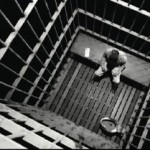
 Your room is the size of a small closet. Your walls are either padded or concrete. You have a toilet bolted to the floor, a steel door with a slot guards open to shove your food tray in, and, if you’re lucky, that door has a narrow window facing a blank wall across the corridor. Your ‘bed’ is a concrete shelf built into the cell and you’re given a thin mat to sleep on. You’re allowed out of your cell for one hour per day to exercise. You’re taken, alone, to a 20-foot concrete, windowless pen, which only provides you with a larger area to pace. You are completely deprived of natural light. You are not allowed to participate in any group activities and you’re denied access to prison services. You are never permitted to touch another person, occupy the same space as another person, or have normal conversations.
Whether to place inmates in solitary and how long to leave them there is at the sole discretion of prison officials. There is no oversight and there are no appeals.
There is, however, immense emotional, psychological, and physical damage.
 Research has shown after only a few days in isolation, EEG readings shift toward abnormal patterns characteristic of delirium. After a few weeks, the person becomes hypersensitive to stimuli. He/she becomes startled and agitated by ordinary sights, sounds and smells. Memory becomes impaired. The person may have fits of anger, chronic anxiety and/or panic attacks. Soon brain function decreases. Sleep disorders set in. Eye muscles atrophy because they are never used for distance vision. Hallucinations become commonplace.
Maybe you’re thinking, So what? These people broke the law and they’re being punished. At least these Supermax prisons and isolation cells save taxpayers money.
Wrong.
Supermax prisons cost two to three times more to build than conventional prisons. And that’s only the beginning. According to one study, the average cost of housing an inmate in solitary is $75,000 per year, while the cost for general population is only $25,000. Supermaxes require more correctional officers, because inmates can do absolutely nothing for themselves. Everything must be delivered to the prisoner, and correctional officers often work in pairs.
An interesting statistic on cost effectiveness comes out of Mississippi. Prisons there diverted the mentally ill inmates out of solitary confinement and reduced their Supermax population by almost 90%. Eventually, they closed the unit altogether. Prison violence rates have since dropped 70%, and that state saves $8 million annually.
 We’ve all heard the “revolving door” comment about prisons. Our recidivism rate is sky high, with most estimates approaching 70%. Isolation cells in Supermax prisons will only ensure that number continues to rise. Inmates – human beings – deprived of normal human contact simply cannot reintegrate into society properly. This is a fact. Yet, data from California and Colorado show nearly 40% of inmates are released directly from isolation into our neighborhoods. Numbers in other states show a similar pattern.
We are isolating people for years, destroying their minds, then simply opening the door and setting them free.
 I’ll leave you with this final bit of information to contemplate. In 1829, Eastern State Penitentiary in Philadelphia became the first to implement solitary confinement. By the late 1800s, documented evidence proved isolation caused inmates to hallucinate, commit suicide, and/or become violently insane. The practice was deemed uniquely cruel and abolished.
In the 1970s, our War on Drugs began filling our prisons at an alarming rate. Overcrowding led to violence. Our answer was Supermax prisons. Solitary confinement with a modern twist. History has taught us nothing.
Please click to below to view Darcia’s Helle’s previous posts:
Al Capone Could Not Bribe the Rock: Alcatraz, Fortress of Doom
Cyberspace, Darknet, Murder-for-Hire and the Invisible Black Machine
 Darcia Helle lives in a fictional world with a husband who is sometimes real. Their house is ruled by spoiled dogs and cats and the occasional dust bunny.
Suspense, random blood splatter and mismatched socks consume Darcia’s days. She writes because the characters trespassing through her mind leave her no alternative. Only then are the voices free to haunt someone else’s mind.
Join Darcia in her fictional world: www.QuietFuryBooks.com
The characters await you.
If you enjoyed this article, please consider sharing it!







Dacia, great article. Too often, prisons have become moder day asylums for the criminally mental ill. Those suffering from schizophrenia are not receiving the treatment necessary while incarcerated in prison.
Sadly, the prison experience often intensifies their mental illness. Prisons are not meant to be mental hospitals. Seems to be one of those “out of sight, out of mind” aspects of our justice system.
Thank you Darcia for writing this article! It cannot remained untold that human beings are being tortured mentally and physically because they suffer from mental illness, took or sold drugs or are convicted of minor offences.
Actually, I don’t believe that any inmate should be in solitary confinement 23 hours a day. There are other ways to manager their ‘correctional program’.
Meant It cannot remain untold! I get so upset just thinking about this situation.
I’m with you, Lise. It’s barbaric and inexcusable.
It’s a shameful reflection on the state of our society that the prison system has taken over the job of the mental health system. If identification, assessment, treatment interventions were performed when people are beginning to show signs of mental health issues, many of those people might not become recidivists. I bet it’s not difficult to figure out the more efficient and less expensive way to deal with these issues and the end result would be a higher functioning society.
Great article by the way, I enjoyed reading it 😀
Thank you, Bill.
Maybe if we all make enough noise, someone will start listening and these things will change. I’m holding out hope.
I like this article Darcia, it could come in very handy. Thank you for posting it. Will might be experiencing some of this soon.
Jody, I feel bad for your characters. Will is in for a difficult journey!
I enjoyed your article, Darcia. Many studies have documented the fact that solitary confinement for more than just a few days can cause otherwise mentally stable persons to become psychotic. For that reason, solitary confinement has been outlawed by international law, as “cruel and unusual” punishment. Nevertheless, driven by the prison-industrial-corporate complex, the desire for private profits (i.e., Corrections Corporation of America), and mandatory-minimum sentences, the rate of solitary confinement of prisoners in the U.S. has steadily grown over the last 30 years. Largely gone are the days when rehabilitation was one of the main goals of the criminal justice system. Now, it’s mostly about imposing draconian sentences upon defendants and driving up corporate profits.
You’re so right, Rick. Turning prisons over to the private, for-profit industry was a huge mistake. They now have every incentive to keep prisoners inside, and no incentive whatsoever to rehabilitate.
Excellent post, Darcia. Very clear presentation of the facts. Solitary confinement is a form of torture. A while back here in California prisoners went on a hunger strike to protest treatment in prisons such as Pelican Bay. They had a very sensible list of demands. Putting an end to ISO was at the top of the list. Unfortunately, the public at large would not engage with the issue. The corporate media basically ignored the story. The authorities told the prisoners, “screw you.” A sad commentary on our times. A large number of people just don’t care about human rights in prisons. I don’t understand it. It’s infuriating.
I don’t understand the public’s silence on this issue, either. Too many people just don’t want to hear about it. They assume criminals deserve whatever punishment they receive.
The mainstream media’s silence never surprises me. They’re controlled by owners with very specific intents and beliefs. We don’t have any real investigative journalism anymore, which is a big part of the problem with raising public awareness.
And what to say about prison profiteers who fill their pockets while inmates suffer in their cage? Same thing with the phone companies. Nyki Kish talks about in on her blog. Inmates have to choose between food or calling their children.
http://youtu.be/_A3VfpTJzGc
Lise, you don’t even want to get me started on this stuff. Have you read Women Behind Bars by Silja J.A. Talvi? Horrifying stuff. The women in some of these prisons aren’t even given enough tampons or pads, and if they don’t have money to buy them they have to wad torn up sheets into their underwear.
No but I will. I heard so many horor stories about this.
‘Horror’ that I can’t spell today!
[…] The Terror of ISO: A Descent into Madness […]
[…] The Terror of ISO: A Descent into Madness […]
[…] The Terror of ISO: A Descent into Madness […]
[…] The Terror of ISO: A Descent into Madness […]
[…] The Terror of ISO: A Descent into Madness […]
[…] The Terror of ISO: A Descent into Madness […]
[…] The Terror of ISO: A Descent into Madness […]
[…] The Terror of ISO: A Descent into Madness […]
[…] The Terror of ISO: A Descent into Madness […]
[…] The Terror of ISO: A Descent into Madness […]
[…] The Terror of ISO: A Descent into Madness […]
[…] The Terror of ISO: A Descent into Madness […]
[…] The Terror of ISO: A Descent into Madness […]
[…] The Terror of ISO: A Descent into Madness […]
Have any of you heard about the Nikko Jenkins fiasco in Nebraska? To very briefly summarize, Nikko has spent most of his life incarcerated (since age 14, I think), much of this time in solitary confinement. His release date was approaching and he wanted to be sent to the Regional Center Hospital instead of going back onto the streets. The Regional Center didn’t want him, suddenly there was no room. He said the Egyptian God in his head told him if he was released, he would have to kill people. He was not allowed to participate in any mental health programming, group therapy, or opportunities to learn about life on the “outside” because he was not allowed to integrate in any way with other inmates, (not even through teleconferencing). I think he got to talk to a psychiatrist through his door every few months. He didn’t want to take medication from the prison psychiatrist because he was distrustful and paranoid, but he was okay with taking meds from the Douglas County Jail. He served out his sentence and was released directly from solitary confinement to the streets. Within the next few weeks, he killed four people. The State of Nebraska and the Department of Corrections absolutely failed this man. The Ombudsman wrote up a fascinating 80 page report detailing how such a horrible thing happened. There was a lot of back and forth debate about whether Nikko was faking being crazy, or not. If he had a mental condition, what was it? Should he be in a hospital or correctional facility? Is he competent to stand trial? Should he get the death penalty? It led to deep scrutiny of the Department of Corrections as a whole, people lost their jobs, victim’s families sued, etc. But, I said I would keep this brief. Newspapers and local news networks looked into Jenkins’ family history and there have been so many criminals in his line of heritage that I don’t know how anyone from a family like that could ever stand a chance. It’s a very sad, sad situation.
http://journalstar.com/news/local/911/read-the-ombudsman-s-report-on-nikko-jenkins/pdf_70f67797-bdce-5325-a78f-697b86987ffc.html
http://dataomaha.com/media/timeline/
Nebraskans are also in the midst of a shameful death penalty crisis. The Legislature (including our beloved Ernie Chambers) voted to repeal the death penalty, the Governor vetoed it, the Legislature overrode the veto. Governor Pricketts (not a typo, hehe) offered up hundreds of thousands of his own money to pay for death sentences to be carried out and buy the lethal injection drugs on the black market from India or someplace. On the 4th of July in Seward, Nebraska, “The 4th of July City,” during the holiday parade, Pricketts and some of his minions walked the parade route waving their petitions to repeal the repeal of the death penalty. People attending the parade, were repeatedly harrassed to sign the petitions. And totally breaking with tradition, when the little kids asked for candy and stickers, he said, “Sorry, they didn’t give me any money for candy.” This from the CEO of TD Ameritrade? Are you kidding? Seriously, it’s shameful to be a Nebraskan right now (until the next few weeks when our entire state is distracted by the cult of the “Big Red N”).
Oh, yeah…I was going to be brief. Hehe.
Excellent comment. THX very much!