
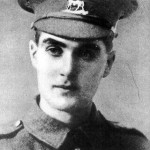
Will the Legendary and Victimless Murder by Arthur Rouse Finally Be Solved?
by Bob Couttie
No one doubts that brain-damaged World War One veteran Arthur Rouse was rightfully hanged as a murderer on March 10 1931. The strangest thing about his case is that, to this day, his victim has never been identified but that may be about to change with the emergence of DNA evidence.
It was the early hours of 6 November 1930 and England was aflame. Throughout the country effigies burned on great bonfires and fireworks exploded overhead in the annual celebration of the failure of the Gunpowder Plot of 1605, an extremist Catholic attempt to assassinate King James I, wipe out the House of Lords and install a Catholic monarch on the shared thrones of England and Scotland.
 Another fire that night should have gone unnoticed, hiding in plain sight. But two young men returning from Northampton to their homes in Hardington saw a fire near the road and thought they’d check it out. What they found was a 1928 model Morris Minor in flames. A figure was seen emerging from a nearby ditch and running away. They reported it to the police, who arrived and extinguished the flames. The car was gutted.
Constable Bert Copping checked the car and found what he at first thought was a rugby ball. Looking closer he realised that it was a human skull.
 The remains were taken to a nearby pub, the Crown Inn at Hardington and Bernard Spilsbury, the star Home Office pathologist, was called in. It was said that the presence of Spilsbury at a crime scene guaranteed a death sentence for the accused, even if innocent.
Local police officers made several errors: They took no scene of crime photographs and removed the body from the car before Spilsbury arrived. Later, At Rouse’s trial they gave evidence from memory, not from notes taken at the time.
The car numberplate eventually led to travelling salesman Alfred Arthur Rouse who lived in London’s North Finchley. His wife didn’t know where he was until 7 November when he turned up and went to the police station.
 His story was that he had picked up the victim, whom he would not or could not name, and was giving him a lift. He had stopped to relieve himself, turned and found the car engulfed in flames. He had attempted to pull the victim from the car but the heat was too intense.
Someone leaked Rouse’s police statements to the press. He spoke about having a harem of girlfriends, to one of whom he was engaged, although he was already married, and had children with several of them. Most damning was his comment that the victim was someone no-one would miss.
Meanwhile it was a motor car expert who examined the burned-out car who sealed Rouse’s fate. Someone had interfered with the vehicle’s carburetor, turning a nut and screw by force which allowed petrol to flow into the vehicle.
With the discovery of a wooden mallet with human hairs underneath the car, the method and means of the murder became clear. The victim had been smashed over the head with the mallet, the car dowsed with petrol and set alight.
But what was Rouse’s motive? While serving in France during World War One he had been injured by an exploding shell which left a piece of shrapnel in his brain. Surgeons removed the shrapnel but Rouse was left with a personality disorder: An insatiable sexual appetite.
 It was that appetite that led to his harem of girlfriends, several bigamous marriages and several children. From that came several cases for child support which were driving him into debt.
To get out of debt he conceived the scheme to fake his own death and assume a new identity.
A high-profile trial, dubbed “The Burning Car Murder”, followed. Rouse was found guilty and hanged at Bedford Jail by executioner Thomas Ellis on March 10 1932.
He went to his grave without revealing the name of his victim. The victim himself is buried at St Edmund’s Church in Hardington in a simple grave marked “In memory of an unknown man”.
The man, however, may not remain unknown for much longer.
Samantha Hall was researching her family history when her grandmother told her that family members had long believed that a missing uncle, William Briggs, was the victim. He had gone to a doctor’s appointment about the time of the murder and never returned.
 In the 1950s the family asked Northamptonshire police to reopen the case. Little could be determined at that time to confirm their belief but in 2012, now that DNA analysis was available, the chances of confirmation were suddenly increased.
A couple of tissue samples gathered by Spilsbury have survived the years at the Royal London Hospital Museum. A mitrochondrial DNA, mtDNA, profile has been exacted by researchers at Queen Mary College. Mitochondrial DNA, which passes down the maternal line, will allow comparison with loving family members and determine whether William Briggs was the victim.
Soon the results of the tests will be revealed in a BBC television daytime programme. Perhaps now, after more than eight decades of anonymity, Rouse’s sad victim will be able to speak his name from beyond the grave.
Postscript
The DNA tests showed that Briggs was definitely not Rouse’s murder victim, leaving two unsolved mysteries on the books: Who did Rouse murder and what happened to the missing William Briggs?
Listen to Orson Welles’s radio dramatisation of the case, “The Old Wooden Mallet” here.
If you enjoyed this article, please consider sharing it!






Excellent post, Bob. I was disappointed to hear that the DNA tests were negative for Briggs. Hopefully the victim’s identity will be discovered at some point in the not-too-distant future, perhaps even through a familial DNA match with samples taken from incarcerated individuals.
Another fascinating read, Bob. I enjoy the style and clarity you bring to these cases. What a bizarre crime. It seems that head trauma (as in Rouse’s war injury) frequently leads to aberrant criminal behavior.