

More Hard Knocks for Amanda Knox: Prosecution Claims Unflushed Toilet Triggered Murder of Meredith Kercher
commentary by Patrick H. Moore
Amanda Knox and Raffaele Sollecito were convicted of murdering Meredith Kercher’s in Perugia in 2009. They were sentenced to 26 and 25 years in prison, respectively. Two years later, their convictions were overturned on appeal and they were released from custody. Then, in 2013, those acquittals were themselves overturned by the high court of Italy in Rome, which meant the case went back to the appellate level to be tried again.
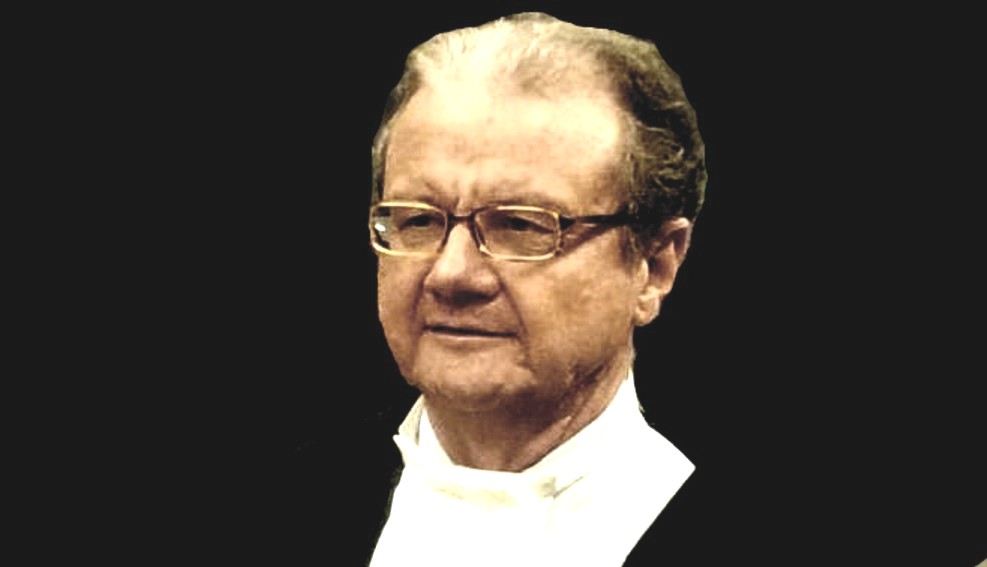 The Italian judicial system loves to drag things out, a fact which was amply demonstrated by current prosecutor Alessandro Crini’s closing arguments which took place on Monday and Tuesday of this week and consumed approximately ten hours, an amazing phenomenon which may find a foothold in the Guinness Book of Records for one of the longest closing statements on record. Or maybe it’s always this way in high profile Italian cases. I’m not sure.
The current appeal — which is not a retrial or “double jeopardy” but a continuation of the same judicial procedure that began many moons ago — began in Florence on September 30th. A verdict is expected on or around January 10th, 2014. Once the verdict is official, it’s still not official; rather, it will once again be taken up by Italy’s high court to rule on the validity of the outcome of this appeal. In Italy, the land of never-ending jurisprudence, no case is officially closed until the high court signs off on it.
In his closing statements, Crini focused on both forensic and circumstantial evidence. In what may not come as somewhat of a surprise, in his statements, Crini seemed to be tipping the scales against Knox, apparently viewing her as substantially more guilty than Raffaele Sollecito.
 Crini has abandoned the unsupportable theory that Kercher’s murder was the result of sex games gone wrong. Rather, he has introduced the notion that bad feelings between Kercher and Knox over issues of cleanliness were what triggered the savage and fatal attack. More specifically, Crini argued that Rudy Guede – the Ivory Coast native now nearing the end of a fast-tracked 16-year sentence for the murder — may have ramped up tensions between Knox and Kercher by defecating in a toilet inside the the womens’ apartment and failing to flush.
Crini insisted that the evidence showed that Guede, who was friendly with young men living in a neighboring apartment, had done the exact same thing the previous week:
“It is an absolutely disgusting and incongruous habit that he evidently had,” said Crini.
Well, this is certainly strange but I suppose it is possible that Guede and Knox and Sollecito were sufficiently angered by Kercher’s distaste for the non-flush approach to defecation that they murdered her to shut her up. There is some evidence that Knox was certainly not perturbed by the idea — given that when she returned to the apartment the morning following the murder and took a shower, she didn’t bother to flush the toilet but rather left the residue there in the bowl. Of course, if Knox was aware at that juncture that Kercher had been murdered, it’s entirely possible — if not probable — that she declined to flush because she wanted the residue to be discovered by the authorities, thus proving that Guede was at the scene of the crime.
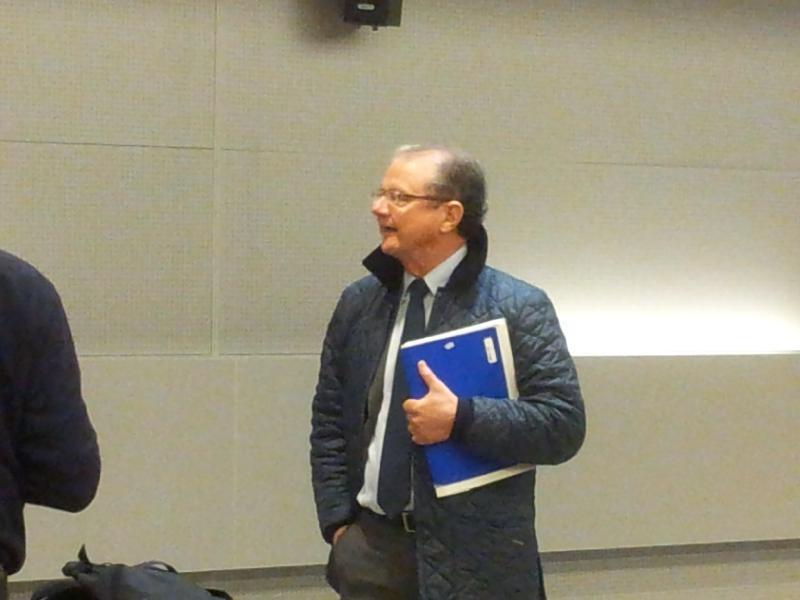 So in essence, Crini appears to be stating that the residue in the unflushed toilet is emblematic, symbolic if you will, of the ongoing feud between Kercher and Knox over habits of hygiene.
Crini, however, is obviously not hanging his entire “prosecutorial hat” on the “turd in the toilet” theory. If fact, he asked the court to consider all the evidence used to convict Knox and Sollecito in 2009, three pieces of which are circumstantial in nature. This is the testimony that the first appellate court dismissed which is now back in play.
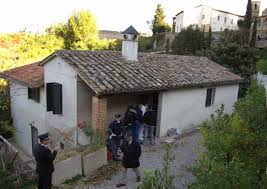 Crini told the court that they should not ignore the testimony by Nara Capezzali, an elderly neighbor who testified that she heard a blood curdling scream the night Kercher was murdered, followed by what she said were several people running away from the house and up the metal steps near her home. (This strikes me as a weak argument since it could have been anyone running up the metal steps.)
- Crini also told the court not to ignore the testimony by Antonio Curatolo, a homeless man who has since died, who said he saw Knox and Sollecito arguing and agitated late on the night of the murder as they allegedly looked over the crime scene from a perch near where he slept on a park bench. (This would appear to be much stronger assuming that the Signor Curatolo was acquainted — at least in passing — with Knox and Sollecito, thus rendering him able to identify them.
- Crini also said the court needed to believe the testimony by Marco Quintavalle, a storeowner who claimed he saw a woman who looked like Knox buying bleach and cleaning supplies the morning after the murder. (This piece of evidence could certainly carry some weight in the eyes of the Court.)
The DNA Evidence:
In my opinion, the unflushed toilet theory in combination with the circumstantial evidence is not sufficiently strong by itself to convict Knox. For the Court to ultimately choose to convict the American girl, it will — I believe — have to be swayed by the DNA evidence which is as follows:
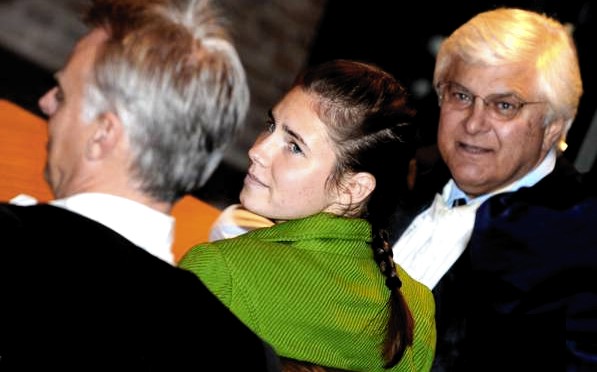 A knife that the prosecution claims was the murder weapon was found in Sollecito’s apartment during the initial days of the investigation. A tiny bit of DNA, which the prosecution maintains belonged to Kercher, was found in a tiny groove on the blade. There has been some controversy all along because the spot was too small to double-test, and it had to be amplified beyond the standard measures of practice in forensic science. In the original trial, DNA attributable to Knox was found on the handle of the knife. That, together with the alleged Kercher DNA, was the crucial evidence that was instrumental in convicting the Seattle native. During the first appeal, the tiny speck of Kercher’s DNA was deemed inconclusive by independent experts because it was too small to double-test.
Now, however, because the first appellate court’s acquittal has been thrown out, the DNA evidence is back in play and the fact that both Kercher and Knox’s DNA were arguably found on the knife could certainly work against Knox. Furthermore, when the knife was re-rested during the new appeal, a new examination of a previously untested spot on the blade near the handle again proved that Knox had at some point held the knife.
 Naturally, in his closing statements, Crini asked that the original findings — that Kercher’s DNA is on the blade — be considered in their final verdict in the new appeal. His contention is that the new tests prove conclusively that Knox was the murderer.
* * * * *
There is little doubt that Crini’s focus on Knox is intended, among other things, to demonstrate that he believes the American is far more culpable than Sollecito. On Monday, Crini did not ask that the court to consider forensic evidence used to convict Sollecito in the first trial—namely, his DNA on the metal hook from Kercher’s bra clasp.
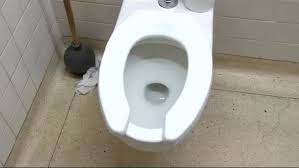 Crini insists that Knox and Sollecito’s alibis are not tenable, especially given the number of times their stories changed during the initial investigation. Returning to his “unflushed toilet” theory, Crini also asked the court to consider whether Knox’s actions were normal the morning after the murder and why she did not flush the toilet when she noticed feces in it. Crini insisted that surely anyone would flush the toilet under any normal circumstance:
“Why leave the toilet unflushed?” he asked.
Crini also suggested that the fact Knox was not alarmed when she returned to the apartment in the morning and found that the door open, even though no one was home, was not normal.
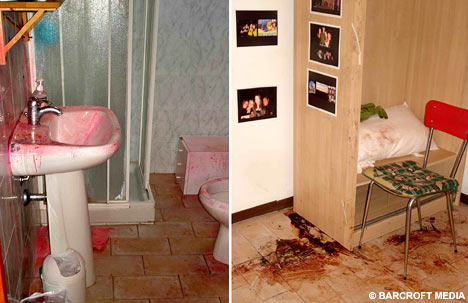 On Monday, Crini wrapped up his closing arguments by asking asking the court “not to make the same mistakes” as the first appellate court in Perugia. “When you separate the elements rather than uniting them, you lose the whole picture,” he said.
Knox and Sollecito’s defense teams will have their chance to refute Crini’s claims on December 16 and 17 when the court will once again be in session. They are expected to try and deflate Crini’s arguments by claiming that the prosecution’s radical switch from sex games to the “toilet theory” is a sign of confusion and desperation on their part. Meanwhile, everyone who is heavily invested in the outcome of this compelling matter will just have to sweat it out for another 46 days.
Note: Much of the factual content cited in this post was drawn from an article by Barbie Latza Nadeau of the Daily Beast posted on Nov. 25, 2013 and an article by Colleen Barry of the Associated Press dated Nov. 26, 2013.
If you enjoyed this article, please consider sharing it!


Seems to me it is mere linguistic metaphysics to say this is not double jeopardy. Clearly the prosecutor is prosecuting, the defense is defending, and judge and jury are listening and pondering, after which they will deliver a verdict. That is clearly a trial by any common usage of ordinary language, and Knox/ Solecito served two years in prison after conviction at one such trial in 2009.
The United States could not adopt the Italian system — a “series of trials” as part on a “single process” — even if it wanted because, of course, that is double jeopardy. We would first have to repel the Fifth Amendment.
Very profound comment which is why I strongly object to the never-ending judicial process which is being played out and in the process is causing considerable tension and suffering for both Meredith Kercher’s family and Amanda Knox’s family.
Nice phrase: “linguistic metaphysics”
It is a defendant friendly process that gives them several chances to argue their innocence, as opposed to an American process that might well have asked for the death penalty in her home state of Washington and not given her much chance after the first court found her guilty.
I would also point out that many American defendants find themselves receiving substantially more severe punishment on far less circumstantial evidence, and you are omitting the other pieces of evidence, including the staged break in, the bathmat foot print, the many measurements compatible with Sollecito’s foot, evidence of clean up, mixed blood trace on the faucet, mixed DNA, and that Sollecito never withdrew his denial of Amanda’s alibi. Just clammed up.
Ultimately, it is an Italian Judicial process, and she will face Italian law. Just like with the Italian recently apprehended in Seattle for murder, I think the end result will be just.
i know you do which, fortunately, is your right.
I will be holding you to that final paragraph Ergon.If not this time around…definitely the next. And can we assume then that you will desist from commenting on/promoting guilt when that happens?
Are you moving the goal posts further, Annella, to when ECHR dumps her petition and the extradition process might eventually get resolved? As far as I know, I’ll be here until the Supreme Court ruling. And I’ve already been challenged on that question before, and my response was, yes, I will respect the Supreme Court’s decision, whether I agree with it or not. Will you say the same?
Mark – As regards the issue of double jeopardy, that legal concept would apply only if the finder of fact, after a trial, determined that Knox and Sollecito were not guilty, and thereafter, an appeals court set aside those not guilty verdicts. For that reason, you never see government appeals of not guilty verdicts in the U.S.; once a defendant is acquitted, that is the end of the case. However, the obverse occurred in the Knox case: first, a guilty verdict by the jury, and second, a reversal of that guilty verdict on appeal. Accordingly, no double jeopardy concerns have been implicated by the Italian appeals process in the Knox case.
The same phenomenon that occurred in the Knox case happens in the U.S. with some regularity: a guilty jury verdict is set aside on appeal and the case is remanded to the trial court for a new trial or for further proceedings. In U.S. criminal cases where a guilty jury verdict is reversed on appeal, the government may appeal such reversal of the guilty verdict to the next appellate level (i.e., to a State Supreme Court for State cases or the U.S. Supreme Court for Federal cases), all without running afoul of the double jeopardy clause. Thus, unless and until a defendant has been acquitted by a jury of his/her peers (or a jury has been duly empaneled and the prosecution thereafter dismisses the charges), double jeopardy has not attached, regardless of what happens during the appeals process.
Rick,
You are confusing an appeal with a trial.
A successful appeal will result in a new trial, but is not an acquittal. The defendant is still charged with the crime and can only be acquitted by a trial verdict of not guilty.
You appear to be saying the prosecution can appeal the decision to grant a convicted defendant a new trial.
They most certainly cannot appeal the acquittal of a defendant at trial. That would be double jeopardy and is allowed in Italy but not here.
Not only does Canada and Mexico have a similar process by which an acquittal can be appealed by a Crown attorney or Justice prosecutor, but the US did extradite someone to Mexico a while back without consideration of the ‘double jeopardy’ argument you raise.
Why do you not accept the first stage of a three part process, cling to the second stage, even after it has been annulled, then decry the third part?
Willful blindness?
RE: “Why do you not accept the first stage of a three part process, cling to the second stage, even after it has been annulled, then decry the third part?”
Ergon,
I merely said the appeal of an acquittal is called double jeopardy in the United States and is prohibited by the Fifth Amendment.
Here is the Italian “process” …
(1) Knox/ Sollecito were convicted by the Massai court.
(2) The first appeal of a criminal conviction is automatic in Italy and overturned the conviction, but it was not an acquittal and they were ordered to retrial.
(3) The Hellman court acquitted them by reason of innocence and set them free.
(4) The Prosecution then appealed to the Supreme Court. It overturned the Hellmann acquittal, which did not reinstate the conviction but again sent them back to retrial.
This overturning of their acquittal has forced the defendants to face retrial on the same charges for which they were acquitted by the Hellmann court.
This is called double jeopardy in the United States and it is prohibited by the Fifth Amendment.
It is not prohibited in Italy.
Some also argue that it is not double jeopardy by the U.S. definition, but the argument is sophisticated and difficult to follow.
I think Rick explained the process very well,Mark, and seeing as how he used to be an Assistant US attorney, and if you still can’t grasp it, nothing I say will change your mind. Cheers!
Re: “Thus, unless and until a defendant has been acquitted by a jury of his/her peers (or a jury has been duly empaneled and the prosecution thereafter dismisses the charges), double jeopardy has not attached, regardless of what happens during the appeals process.”
The Hellman court that acquitted Knox and Sollecito sat a jury of five women and one man.
The first, Massei court, had a ‘jury’ too, and in the American system, their decision to convict Amanda Knox would in most cases have been game over for her, and if there had been a successful appeal, the process would have been exactly the same as happened in Italy.
But you are indeed, blind, and not being satisfied with Rick’s explanation, are going to keep at it until what, he agrees with you?
Carry on
RE: “The first, Massei court, had a ‘jury’ too, and in the American system, their decision to convict Amanda Knox would in most cases have been game over for her, and if there had been a successful appeal, the process would have been exactly the same as happened in Italy.”
What does this have to do with double jeopardy?
That you can’t pick and choose elements of two different judicial systems in order to bolster your Google-y justification for Amanda Knox not to be extradited. Most people might be impressed by simplified “double jeopardy” explanations from friends of Amanda, but, thinking people in the Department of Justice and State Department already know the double jeopardy provisions don’t apply here. As has already been explained to you.
Bollox.
Yes, that is the Italian argument.
Moving on, then. Leonard Peltier? Mumia Abu Jamal? Edward Snowden? Guilty or not?
I’ll just write something about the Process, some day.
That was a important turd one would think ! One can never be surprised sometimes at lengths law officers will go if they think they have right person pegged! I know that for sure
Hi Patrick,
You don’t seem to have grasped the significance of Nara Capezzali’s testimony for a couple of reasons.
First, you are not aware of everything she said and because you have relied on Barbie Nadeau’s summary of her testimony rather than her actual testimony. Nara Capezzali testified that she had heard running on the metal stairs and on the gravel path of the cottage shortly after she had heard the protracted scream. It’s logical to link the sound of people running away from the cottage with the loud scream, especially as she heard running on the gravel path of the cottage.
Second, you’ve evaluated her partial testimony in isolation rather than in the context of other pieces of evidence. Prosecutors Galati and Crini and the judges from the Supreme Court have pointed out that all the evidence has to be considered wholly, not separately, piece by piece. Rudy Guede’s bloody footprints led straight out of Meredith’s room and out of the cottage. This indicates that he left the cottage almost immediately after Meredith had been stabbed which corroborates Nara Capezalli’s testimony that she heard people running away from the cottage shortly after the scream. The Scientific Police used to Luminol to reveal the bloody footprints of two other people at the cottage. It’s not a coincidence that these footprints were compatible with Knox and Sollecito’s feet. Nara Capezzali claimed that several people ran away from the cottage after the scream. Her testimony fits with the other pieces of DNA and forensic evidence which prove there were multiple attackers.
Nara Capezzali’s bathroom widow was directly above the cottage, I estimate a distance of 40 meters. I also took photographs of the steel stairs people were heard running up to the street, they are bloody noisy indeed, especially late at night where there is hardly any traffic, and the natural amphitheater formation of the valley funnels sound directly up towards her window.
Lastly, Antonio Curatolo observed Knox and Sollecito returning to the square later that night from the direction of the street that is accessed by the stairs.
Paul Ciolino of CBS is a lazy, overpaid, ‘investigator’.
“… the Supreme Court have pointed out that all the evidence has to be considered wholly, not separately, piece by piece…”
Most of the witnesses have no connection with the accused or the victim and they testified under oath. They have no incentive to lie. And they contribute only a small piece in the huge jigsaw puzzle.
That a certain testimony will not support the cause proposed by the FoA is not the best argument to discard a testimony. I have said this elsewhere but there is no reason for not to repeat it again and again…
When you collect evidences you do not worry whether it is going to fit your pet theory. You collect the evidence based on the quality and reliabilty.
When you are in the court, you are going to ensure that all the evidences fit together in a coherent theme. You should not criticise the quality and reliability of the evidences at that time. If you must discard some evidences, you need to present convincing reasons.
For example, I cannot answer why there are some peaks that are unidentified in the DNA analysis report of the samplece from the bra clasp. For me, the correct question is “is RS DNA present in the sample?” and my answer will be “yes”. I am not discarding usable information in this process, I am just trying to fit the available information in a coherent picture.
Only difference is that lawyers get paid to muddy the case.
I like that. Lawyers get paid to muddy the case. Ain’t it the truth. Legal disinformation. As the world turns.
You and Ergon are the pro-Kercher mystics.
I am the mystic of neutrality.
PHM
I was not sure whether to use “muddy the case” or “stir the pot” but I thought FoA may feel offended if I mention “the pot”. If I am further attacked by the “linguistic metaphysics”, I will not be able to hide (and cannot run anyway at this ripe age).
But honestly, I think Crini’s presentation of the evidence is brilliant but his summary (leftovers of the kebab by RG) and the reopening of the calunnia charges got me floored.
But you must agree that once the mud settles, the water will be far more clearer than it was before. I did not mean it to offend.
No, I do not belive the unflushed toilet story.
Well, I have committed the crime more than once.
Seriously speaking, I do think that the friction between the two got precipitated on the halloween eve.
AK was keen to go with the party (apparently) but she felt slighted.
The vampire dress and the fake blood triggered something.
The lover-boy too felt excited somehow and some violent feeling developed.
The plan was hatched in the morning just after Meredith left. RG was not part of the master plan but was included so that he can be conveniently sacrificed.
RS too loves some form of violence and he got a kick out of it.
If the shit didn’t fit, you should not acquit?
The entire prosecution is a pile of crap, so at least he’s consistent.