

Unraveling Justice: Guilty in the Eyes of Banners and Bank Accounts
by Pitchforks
In the immediate aftermath of there being a Guilty verdict in a high-profile and excessively publicized trial, there is often loud mass public jubilation on social media, or even from waiting spectators waving banners outside the courthouse. These expressions of ecstasy are often accompanied by triumphant declarations that faith in the criminal justice system has been restored.
Restored from what? And to what? One Guilty verdict, assuming it is not 100% wrongful, has no significant impact, positive or otherwise, on the integrity of the criminal justice system. That people should attribute such importance to a handful of obscenely media-hyped “successful” cases, cases that – but for the strategically selective prominence that the media ascribe to them – are no different from myriads of other cases in the US, is truly disturbing. It speaks volumes about the general public’s distorted notions of what constitute significant news events, and how their perceptions have been grossly warped by the media.
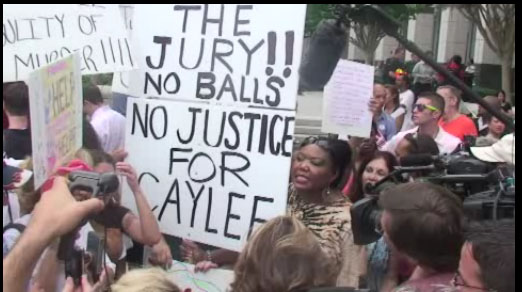 In the last two years, many of these misguided trial groupies have also viewed any eagerly-anticipated Guilty verdict through the fissure-cracked lens of being “just compensation for Casey Anthony!” Two years ago, when Anthony was acquitted in Florida in her capital murder trial the verdict was received as extremely significant in the vast machine that is the US criminal justice system, but for a different reason, the opposite reason – that it made people “lose faith” in the criminal justice system. Just as the quasi-orgasmic reaction to Guilty verdicts is a tad over-the-top, this reaction was wrong-headed in the extreme. Apart from the fact that the outcome was unremarkable given the real evidence – not the irrelevant litany of smut, prosecution creativity and outlandish conjecture propagated by the tabloid media and swallowed as gospel truth by a large number of investigative-murder-porn addicts watching cable TV – it broke no legal precedents nor established any new guidelines as to procedures of judicial practice.
Do any of the whooping, whistling and air-punching punters who congregate outside courthouses for famous trials where Guilty  verdicts are delivered have any idea what is actually happening in the criminal justice system? Do they understand how due process for everyone is being tainted in the US and abroad by prosecutors, judges and law enforcement departments being so aware of today’s media scrutiny and reporting of their minutest decisions and performance styles, even at a local level, that they are either overly-concerned with not arousing public disapproval, or motivated by a lust for public acknowledgement and resultant promotion or political advancement? Sheriff Grady Judd’s self-aggrandizing indictment, now dropped, and privacy-violating exposure of the two pre-adolescents thought to be “responsible” for the suicide of 12-year-old Rebecca Sedwick is just one tacky example of the latter perspective-distorting motivation.
These tendencies have intensified in the US over the past thirty years – increasingly and disturbingly also infecting the juvenile justice system – because of government and media exaggeration about increases in crime rates, and the accompanying misinformation that society has become “soft on crime”. The criminal justice system has been falling over itself to convince the public that more criminals are being swept off the streets and that the incentives to commit crime are being greatly diminished by harsher sentences. The fact that the latter correlation is not borne out by statistics does nothing to assuage the impetus towards putting more people in prison for lesser crimes and for longer terms.
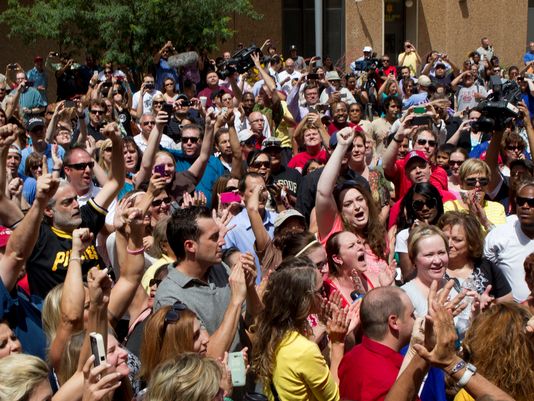 How many of those on courthouse forecourts chanting victoriously “Justice for Travis/Lacey/Michelle!!!” in unison after a Guilty verdict is announced, understand that “justice for all” is being greatly undermined in the US by a lucrative private prison industry insinuating itself into state budgets, with states guaranteeing private prison corporations full capacity for periods as long as twenty years? How many of them are even aware, or care that US incarceration rates are outrageously high, and sentences disproportionately long compared to other countries?
The US incarcerates six times more people than the world average, with 25% of the world’s prison population situated in the US even though America constitutes only 5% of the world’s population. The motivation to put people in prison in the US now has less to do with making society safer than it has with lining the pockets of private prison executives. This situation began to take hold in the late 70’s and early 80’s; since then there has been a dramatically steep climb in the numbers of prisoners in the US, as well as a drastic lengthening of prison terms.
These two broad effects, media scrutiny of the criminal justice system and the move towards increasing numbers of private prisons, in turn affect the minutiae of criminal proceedings, corrupting the processes of arrest, charging, collection of evidence and trial course. Such conditions increase the incentives to plant evidence or use coercive and even illegal interrogation methods on the part of law enforcement, for police officers to lie in court, for prosecutors to hide evidence, influence witnesses’ testimony, and overcharge crimes, and for judges to collude with prosecutors, all with the aim of assuring convictions and obtaining the longest sentences because the imperatives and the rewards are so great.
And putting the icing on the judicial cake is the increasingly widening and insidious contamination of any impending or future jury pool by a tabloid media that peddles simplistic, boiled-down fairy tales with good and evil archetypes, urging their audience to cheer and fawn at the heroes and heroines, and hiss and boo at the monsters and witches as in some tawdry, childish English  pantomime. Murder trials have become a form of immature escapism onto which people project their personal insecurities and prejudices, attaching their anonymous and perhaps unacknowledged private anger and frustration – that in reality comes from their own lives – to a publicly embraced cause célèbre. Like children who appropriately play and fantasize through their fears, anxieties and confusions in order to integrate them, these adults are inappropriately playing out emotions that would be better expressed and employed in their personal lives, not through the media-mythologized personal tragedies and misdemeanours of other heretofore anonymous individuals with whom they have no meaningful connection. Unlike for children, where imagining and role-playing in stories helps them to think, develop, mature and separate fantasy from reality, for adults, such misdirected and excessive investment of one’s negative psychic energy in media-distorted stories only serves to stunt emotional flexibility, grossly limit understanding of the complexities of human nature, and interfere with one’s ability to analyze motivation and evidence without recourse to the illogical and ridiculous.
The public has been brainwashed into thinking that the criminal justice system does not do enough to punish offenders, so it is necessary for the media to take over and prosecute them in collaboration with the public. Members of the public are cajoled into thinking that each one of them is individually important, not only in making sure the defendant is punished – before he or she is tried, as well as after, but also in “supporting” the victim’s family and friends. Suddenly, anonymous individuals all over the country experience the adrenaline rush of feeling significant, that they can “be there for the family” and make sure the defendant gets his or her “just deserts”: character assassination, humiliation, ridicule, sexual exposure, negative interpretation of everything they have ever done in their life, from having the gall to be born with piercing blue eyes to removing a cardigan too many times in court…..
Such public prosecution by the masses is absolutely necessary and justified because years of detention before trial, separation from friends and family, loss of income, undergoing police investigation and public parading in a courtroom are not sufficient to  expose and punish a person while they are supposedly not yet determined to be guilty. A person must be destroyed before they get to trial, just in case they “get off”, and to make sure that as many people know about their awfulness as possible so that hopefully, the jury members will know what the “facts” are and make the “right” decision. The public is complicit with media networks that saturate the airwaves and cyberspace with details about the defendant, however unsubstantiated, particularly during a trial, so that jurors who go home at night are unlikely to avoid “inadvertently” hearing or seeing something that has “need-to-know” value. Even sequestered juries get family visits, and who knows when a hushed, private moment might not be advantageous for a little “updating” about what “everyone” thinks……….and expects. And if the defendant is acquitted because the jury is a bunch of “village idiots”, at least there will be the satisfaction of knowing that they can never live safely again in society. Lest they forget and need a reminder of their correctional-officer-substitute status and a booster of hate-serum, the public can rely on TV networks like HLN to nudge them periodically with references to “what happened in Florida” and nostalgic montages of highlights from trials past, or clips from “narcissistic” interviews given by the defendant.
But these inconvenient, intrusive and complicated matters don’t concern Mary-Lou, the fine upstanding, respectable, patriotic middle-aged citizen milling on the courthouse plaza with her new trial-following buddies who she “met” on the now-defunct In Session chat-room, and formed a daily check-in chat group on the Nancy Grace Facebook page or that blog devoted to “Justice 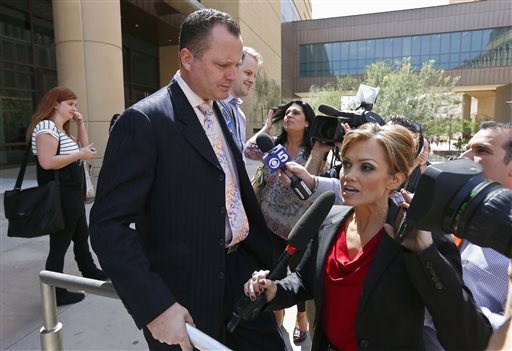 for….!”. They hover as near to Jane-Velez Mitchell and her padded microphone as possible, watching in hushed reverence as she interviews one of the “very close friends of……” who have been cajoled by fawning “sympathy” into supplying the media with their flimsy stories about gut feelings and highly subjective interpretations of photos or video clips on every HLN prime-time show during the course of the trial. The “very close friend” declares vehemently, to the obediently-nodding affirmations of the camera-clamouring traveled-from-Booniesville-to-be-here devotees, that when the verdict was read the defendant had “no emotion” and that she was “smirking” at the jury as each one confirmed their decision. When Mary-Lou gets home – after using up her vacation time for the trial-trip – and delightedly watches the verdict-reading over and over again on TV, she will choose not to notice the close-up of the defendant’s open-mouthed gasp on hearing “Guilty”, nor see her tear-welled eyes, lip-biting and quivering chin, glancing frightened and questioning at each juror in turn as they repeat “Yes”, nor perhaps the subtle cheek-twitching that belies the visage of stoic resignation as a male defendant tries to maintain his composure. They are monsters – HLN and Twitter has taught Mary-Lou that, so she will be blind to the now convicted criminal’s “nonexistent” human reaction.
What is important is that Mary-Lou and her friends get a chance to declare their elation for and allegiance to the victim’s family on camera, a chance to publicly support this innately unremarkable group of victimized, bereaved but glamorized strangers with whom they have no connection whatsoever except via the unctuous tones of “Dr” Drew coaxing them to share their 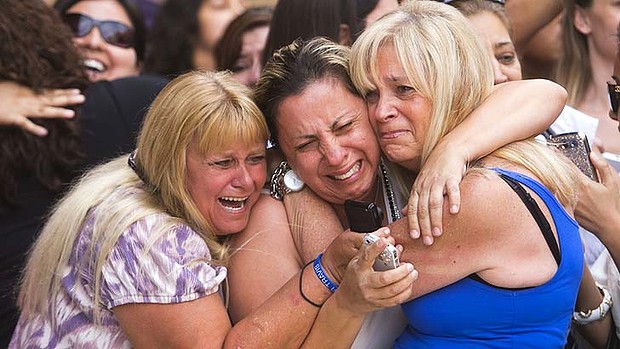 good empathic vibes as well as their now officially-sanctioned despising ridicule of the defendant through their flat-screen TVs. They were so afraid they were going to get another “Casey Anthony”! Justice has finally “unfolded”, as Nancy Grace usually quips in her rare forays into joy…….. for Travis/Lacey/Michelle!!!
Any one of these “Justice for…….” faithful could find themselves one day on the wrong side of the law, or in the wrong place at the wrong time, perhaps fitting the criteria or profile of a certain demographic group and be subjected to police prejudice, deprivation of rights and distortion of interrogation-room statements. If they end up at trial they will be no more immune to media exposure and humiliation than the mugs relegated to one-off mini-posts on Nancy Grace’s Facebook page for humping a sofa on the street because they forgot to take their meds, getting a bit sloshed while celebrating their son’s 19th birthday with him at the bar, or turning a blind eye to their daughter smoking a joint with her friends in the basement – with the music turned up a bit too loud. Your only hope of anonymity beyond the freak side-shows is if you and your relatives and/or the victim are butt-ugly and/or your local rag consigns you to column four of page 22 because it’s Kim Kardashian’s 73rd day of marriage.
These naïve and jubilant citizens are clinging to their misguided notion that the high-profile Guilty verdict for a murder trial is a  victory for the country, rather than what it really is: the arbitrary outcome of a common, though gruesome story of interpersonal violence turned deadly, transformed into a carefully orchestrated and manufactured fake media epic, manipulating the masses and raking in billions in ratings-generated ad revenue. Until now commitment phobia, poopy toilets, cartoon-knickers purchasing and the penetrability of doggy doors have not been social problems that anyone has marched on Capitol Hill about, but somehow these issues have gained more priority in the minds of a segment of the population than some very real threats to societal order and civility and to fair and due process.
High-profile murder trials are very significant, but not for the development or improvement of the criminal justice system. Nothing in the criminal justice system is restored or edified when there is a much-sought Guilty verdict. These trials are significant only for their embodiment and encapsulation of a sick form of brainwashing and media-requisitioning, for their sucking of thousands of duped television and social media followers into a 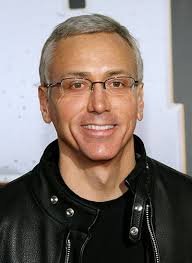 vortex of excessive and misdirected sympathy and emotion, and for the distorted and made-up stories that evolve into unsubstantiated urban legends gracing every supermarket checkout magazine rack. Yes, each one of these trials is a landmark – in perpetuating the ongoing contamination and insidious destruction of the American criminal justice system. Mary-Lou and her friends have made their small but important contribution to this endeavour.
Perhaps this inane and dangerous syndrome can be succinctly summed up in a Twitter reply I received after one particular Guilty verdict, to a tweet I had posted a month before. I had responded to someone who was dismissing the effects of the tabloid media and “true crime” TV, and the person bided their time till they could throw a triumphant retort in my “face”:
Pitchforks: “That type of nonjournalism DOES matter in that taints future jury pools & incites general Pitchfork mentality against due process”
Reply (1 month later): “ha…guess it won’t matter now for that murdering nutbag…..hahahaha”
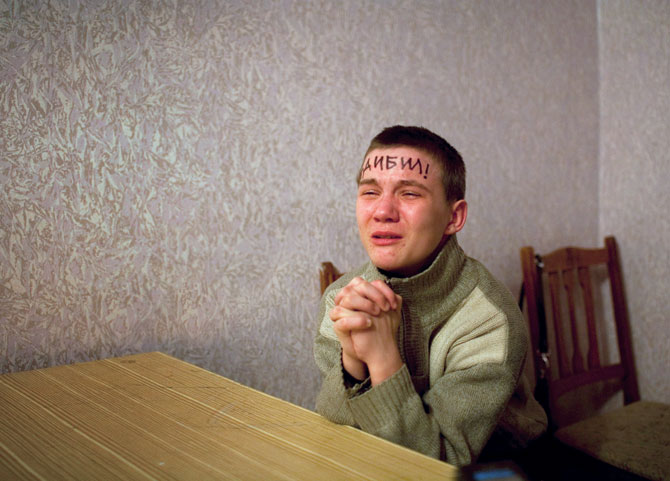 So while Mary-Lou and her internet trial-sisters hug and shed tears of joy, clutching their battered and dog-eared “Justice for……” posters, their rights and freedoms are trickling quietly down the drain, and maybe one of their young adult sons has been stopped by the police while driving to get a pizza and is now sitting in a windowless room being yelled at by a police officer while another one tells him, calmly and encouragingly, that they have a lot of evidence against him…. He is coming close to signing a “confession”, just so he can get out of there and get an aspirin for his thundering headache. He doesn’t know that he could have left hours ago, he doesn’t know that innocent people need to do that thing that Nancy Grace condemns as suspicious – “lawyer up”……… he doesn’t know what his rights are, but he just needs to get out of there and home to Mom, who’ll be back from her trip tonight and hungry for pizza, so at this point………..
But wait, Mary-Lou can’t go home yet – Jane Velez-Mitchell is coming her way, microphone thrusting, and she wants to know how Mary-Lou feels about the verdict! The answer is obvious. Mary-Lou has been well trained:
“Justice has unfolded! Justice for…………!!!!”
 Pitchforks is a child and adolescent development, delinquency and mental health specialist based near Washington DC who writes about the American criminal justice system and its juxtaposition with the media, runs the website Pitchforks, and produces the blogtalkradio show Routing Out.
Links:
Pitchforks: http://babelbooth.com/
Pitchforks on Facebook: https://www.facebook.com/
Pitchforks on Twitter: Pitchforks @PitchforksPosts
Routing Out: http://www.blogtalkradio.com/
Click below to view Pitchfork’s previous posts:
Leading Lambs to Syllabic Slaughter
If you enjoyed this article, please consider sharing it!


A tremendous post, Pitchforks. The fact that all of this tabloid TV trial coverage is used to distort or conceal the facts regarding our criminal justice system is a big problem. Thanks for speaking out. If only the “fans” of these show trials would direct their energy to solving actual problems in society (joblessness, poverty, mental illness, domestic abuse, addiction, etc.), rather than screaming for “gulty verdicts” in front of TV cameras…
One point I would add is that these public “demonstrations” tend to be sanctioned only for a particular group of people in particular circumstances. When African Americans gathered to protest the foot-dragging that followed Trayvon Martin’s murder, they were described as an angry mob of “race baiters” by many in the media. Likewise, when Occupy Wall Street protesters engaged in civil disobediance in cities across the country, many of them ended up being arrested or beaten by police. The media was quick to portray them as unwashed hippies and drug users.
Again, the incarceration rates in America are a huge problem — far worse than any verdict delivered in this or that trial du jour. We need to stay focused on electing people who are clear on how to implement reforms. The War on Drugs and mandatory sentencing requirements and for-profit prisons have got to go. Corporations should not be able to utilize prison labor pools. Prison torture (solitary confinement, beatings) must end. Death penalty must be abolished.
Here’s a fine goal for Americans to pursue together: let’s get rid of the prison-industrial complex and its media enablers.
Thanks, Nashe. Agreed. I do think there is a difference, though, between protests about something that has happened that is seen to reflect a social issue and needs to be acted upon, or perceived inappropriate action by law enforcement or the government and these kind of hanger-on trial groupy gatherings. People in protests are highlighting something wrong they see in society and are being proactive in trying to change it, whether you agree or disagree with their ideology. Trial gatherings, on the other hand, are characterised by indiscriminate following of the banner-headline disseminated party-line and passive fawning sycophancy to the media celeb “analysts” and the rock star prosecutor of the day, simply regurgitating like automatons in unoriginal cliches the slogans of the very media who are raking it in, thanks to their gullibility. Even their active anger when they don’t get the “right” verdict has been manufactured and carefully coached beforehand by the media.
On the one hand we have activism and on the other hand we have duped consumerism.
Pitchforks – You wrote another excellent post! You aptly note that the result of any single jury verdict does not have any real effect on the lives of “trial groupies,” except that it does fill up their otherwise dreary, ennui-”filled” lives. I do not agree with the implication in your post that all (or most) of the defendants in high-profile trials are not guilty. I believe that O.J. Simpson, Scott Peterson, and Casey Anthony were properly or should have been found guilty beyond a reasonable doubt based on the evidence presented at those trials.
As BJW eloquently wrote, a great deal of misinformation and propaganda is involved in the media-hype surrounding these “high-profile” trials. I trace this society’s obsession with the next big “Trial of the Century” to a few phenomena. First, since the late 1990′s, when President Clinton deregulated the media and allowed ownership of the media to be concentrated in the hands of a very few families (i.e., the Murdoch News Empire), the “news has been cancelled.” Instead of being required to serve the “public interest” as a condition for their continued license to broadcast on the public airwaves, the news divisions of the networks were forced to become profit centers rather than the “loss leaders” they were during the Murrow-Cronkite-Chancellor-Brinkley-Rather era. In order to make profits, the networks closed down their news-gathering offices (foreign and domestic bureaus) and focused on lower-cost, easy to cover stories, like selected criminal trials and “human interest” stories, to the exclusion of real reporting on real issues. Sensational trials, especially those with titillating facts and physically attractive defendants or victims, attract higher-ratings and the desired 18-35 year old demographic base to which advertisers flock. As the adage goes: “if it bleeds, it leads.” Media owners also prefer to have the masses focus on tearing each other down and apart rather than addressing real social problems (witness the lack of electronic media coverage of the “Occupy Wall Street” movement in 2011).
Second, the wall-to-wall TV coverage of the O.J. Simpson trial in the mid-1990′s spawned the careers of a new generation of media-trial watchers (Dan Abrams, Jeffrey Toobin, Jane Velez-Mitchell, etc.), made the attorneys, judges, and even key witnesses in the case famous (Johnnie Cochran, Robert Shapiro, Barry Scheck, Robert Kardashian, Judge Lance Ito, Kato Kaelin, Henry Lee, Michael Baden), and gave rise to an entirely new media construct: the 24-hour trial channel (the now-defunct Court TV). So many people watched the O.J. trial on a daily basis during the mid-1990′s that the economies of LA (and possibly elsewhere) began to suffer because everyone without a job stayed home to watch the trial coverage instead of patronizing local businesses. Media moguls realized that they were onto something with this new real crime TV model and they decided to expand it into their prime-time offerings. By about 2000, “reality TV shows” began to take hold across the broadcast spectrum (Survivor, Big Brother, Bachelor/Bachelorette, Living With the Kardashians, etc.), allowing people to vicariously live their lives through the televised exploits of the shows’ “contestants” whom, depending on what the script called for, were to be either canonized or vilified.
Third, due to the 24-hour news cycle, the cable networks were forced to fill their allotted time with banal drivel by trial pundits like Nancy Graceless, Geraldo Rivera, etc. Those broadcasting hours are very easily (and cheaply) filled with a hash, rehash, and re-rehash of the latest details of the current “Trial of the Century.”
Finally, people who “do not have a life” can focus their energies on the latest “demon-defendant” and somehow fool themselves into believing that the conviction and punishment of that person will somehow allay their problems (i.e., unemployment, boredom, mental illness, etc.) rather than look for solutions to their actual predicaments.
Great overview of the history of true crime TV, Rick. I had read that the O.J. trial was a significant turning point, but your info about businesses losing revenue because punters were stuck indoors at the TV is an interesting angle I had not heard before.
I did not mean to imply that most or all defendants in high-profile trials are not guilty, just that the media coverage interferes severely with due process, and that everyone – guilty and not guilty – has a right to unencumbered due process, despite the prejudicial attitude the Graceless One teaches about “criminals” not deserving a defense and defense lawyers all dancing with the devil – in her book no-one is “innocent till proven guilty”, they are already “criminals” once they come under her radar and her hate of defense attorneys makes a nonsense of her law training. How she passed the bar with those beliefs, I do not know. I guess she faked the ethics course, just like she assumes everyone fakes psych evals. Even a serial killer or child molester should not have manufactured salaciousness bandied about as fact, nor be deprived the right to a full and committed defense. In fact, the point that Graceless and her ilk miss is that it is precisely by having a vehement and persuasive defense against charges that, without fiddling of evidence or facts, there is more likely to be certainty, though not foolproof, that the person has been convicted correctly, as that means the damning evidence was so strong it even over-rode reasonable objections to the contrary. What victory is it if the challenge was weak?
The cases I obliquely referred to in the “Justice for…..” citations had nothing to do with my feelings about the guilt or otherwise of the defendant but were examples of high-profile cases with Guilty verdicts in recent times that had a “fan-club” following. My feelings on Casey Anthony, however, are quite specific, and influenced by my professional experience, but we will leave that discussion till another day!
Rick, this is an outstanding exposition on the decline of broadcast journalism in this country. I believe the shift in standards preceded Clinton’s deregulation of the mid to late 1990s. By the late 80′s the golden era of news was over. I became an admirer of Walter Cronkite when I read about his vigilance in maintaining journalistic integrity. On nights when he concluded the broadcast with an opinion piece, he took care to omit his usual “and that’s the way it is…” He didn’t want to compromise his objectivity. To come remotely close to this standard now, I watch BBC News.
But I want to touch on the controversial topic of televised trials. I have a different perspective. While not disputing the down side, the crass entertainment angle, along with the disturbing trend of trial groupies, I’m not opposed to the concept. Courtrooms are typically open to the public, and there is nothing wrong with an interest in the criminal justice system. Nor is there anything mentally unbalanced in following a particular trial. I understand that unstable individuals, including groupies, seem to represent the majority, but I don’t believe this is the case. Not everyone gravitates towards camping out on the courthouse steps with banners, and not everyone is a hate-addicted zombie. By the way, is carrying a banner now restricted to the crazed “haters”? I think not. I actually admire those who take a non-violent path to freedom of speech.
But getting back to televised trials, I don’t view cameras as problematic or wrong. It’s the 24/7 HLN style subjective commentary that’s problematic, at least during the trial. I want to form my own conclusions. I’d like to see judges allow cameras but put a gag order on the out-of-control cable network commentary. Sorry to have rambled on at such length. Thanks to all for your patience. Rick, I’d like your thoughts please at your leisure?