
“Blue Velvet” by David Lynch Demonstrates That Crime Is at the Heart of Our Existence
film review of David Lynch’s “Blue Velvet” by Robert Emmett Murphy, Jr.
“Lynchian” is an adjective the entered the American film vocabulary in the 1980s, generally as a compliment, sometimes a pejorative, referring to a certain sumptuous form of weirdness that seemed to imbued with gravitas, but remained tantalizingly (or maybe simply annoying) opaque. I think it was first coined after this film was released, though it is neither director David Lynch’s first famous, or even his first big-budget A-release. The irony is that this film — the definition of what is “Lynchian” — is in fact one of the most coherent and linear stories of the storied director’s career. “Lynchian” remains an appropriate adjective for this film, though, because in it he never lost sight of his responsibility to act as tour guide to the audience as they wander through his landscape. If the audience is engaged here, they will never be left behind, and because of that, “Blue Velvet” is the key to unlocking the rest of Lynch’s cinematic treasure chest.
 The most simplistic interpretation of this movie is that it’s about how there is always something bad lurking beneath perfect surfaces; but that’s too easy — the director dispenses with the theme fully in the first sequence: Perfect little houses with perfect white picket fences and perfectly manicured yards that almost glow with their luscious green. A middle-aged man, almost comical in his self-satisfaction and comfort, waters his lawn. Then he has a seizure and collapses. A dog comes to drink from the hose that he still grips in his hand. The camera pans away from his helpless form, sweeps close to the blades of grass, parts them, and reveals a colony of grotesque, swarming, bugs.
Lynch establishes that this is a film about two levels of reality — the light and the dark. Had the message only been that both exist, and how close the dark and chaotic reality is to the sunlit world, the film would already be over. But it’s about something more complex; it’s about an original sin that keeps drawing us away from the sunlit world, and how our awareness of that sin is why we invented the lie of the sunlit world in the first place.
 The now-crippled man’s son is played by Kyle MacLachlan. Returning home from college to visit his dad, he has his own accidental encounter with the other world when he finds a human ear lying in the grass. Like the Hardy Boys or Nancy Drew, he investigates the source of that ear.
An important part of this film is that Kyle MacLachlan is the character with whom the audience identifies, but he’s actually not that good a guy. He has limited motive to butt in where he doesn’t belong, and displays less-than-complete moral backbone as he digs deeper into the darker world.
Lynch, a director with not only a gift for weirdness, but with the ability to draw amazing performances from his cast, frequently uses the same people in film after film because of their solidly established forms of professional communication. The director must have made a deliberate decision to ask MacLachlan to give perhaps the most wooden performance of his career, because until very near the end, he’s only two things: a voyeur and a cipher. The voyeur makes him a stand-in for the audience, and the cipher damns him.
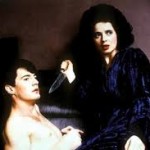
 So MacLachlan traces the ear to a nightclub singer played by Isabella Rossellini. That’s when things really get dark. Our introduction is a scene where MacLachlan is hiding in Rossellini’s closet, watching her abused and then raped by a drug-sniffing pervert played by Dennis Hopper. During the assault, the rapist demands that his victim ritually degrade him. The fact that this is an often repeated ritual is obvious; Rossellini clearly is bound to Hopper in some unspecified form of blackmail/bondage.
It gets worse. Hopper leaves and then Rossellini discovers MacLachlan in the closet. It’s not a surprise that she’s unhappy with the discovery. What is a surprise, though, is that she exploits this moment of power, and forces MacLachan to submit to a sexual exploitation similar to what she just endured at knife point. And then, in complete control, she orders MacLachlan to degrade her in a manner similar to what Hopper had done.
 What emerges is a deep, but thinly sketched, back-story, supported by a bold performance by Rosselini. Hopper and his gang have taken Rosselini’s husband and son hostage. Part of the bargain for their lives is Rosselini’s submission to Hopper. But in that submission, Rosselini got in touch with her own worst desires, and as much as she hates Hopper, she is excited by the degradation of both him and her. Rossellini is full of vulnerability, degeneracy, desperation and longing, yet through it all, the fact that she can still be redeemed isn’t lost on the audience.
Oh yeah, and MacLachlin discovers that he likes hitting her. Unlike Rosselini, he’s not a trapped animal, or at least he thinks he isn’t. He thinks he can travel between the sunlight and the dark and be unaffected. As a tourist, as a voyeur. He’s lying to himself, of course, and to everyone else (as this is going on he’s developing a parallel relationship with “good-girl” Laura Dern, the daughter of the detective investigating the severed ear, which is of both symbolic importance and has plot significance). At one point he offers Dern this disgustingly disingenuous line, “I believe there are opportunities in life for gaining knowledge and experience, but sometimes that means taking a risk.”
(Not for nothing, but doesn’t this sound just a little like Mitt Romney?)
So the story goes back and forth between sunlight, which Lynch obsessively paints as artificial, and darkness, which is mostly presented as filmed through filters of filthy fish-tank water, but still seems more realistically visualized. Lynch clearly has more faith in dark reality than in the light, but he also makes it clear, the less-real world of light is the safer place.
 It’s Hopper’s character that establishes the “should-never-be-crossed” dividing line between the two. Hopper was given this part after destroying a promising career, and deeply savaging everything and everyone in his personal life, through his obsessive self-indulgence. Not long out of rehab, he told Lynch, “I am Frank Booth.” I can think of no other occasion where an actor went so far over-the-top, and did so throughout the entire performance without respite, and never, ever, descended into camp. Hopper’s interpretation of Booth’s evil is as an utter force of nature, as an infantile tantrum blown up with shocking brutality, and it never relents. Lines like, “Let’s fuck – I’ll fuck anything that moves,” represent Booth at his most introspective, and Hopper manages to get it out and make it real, while I suspect most other actors would have to bite back laughter. It was somewhat scandalous later that year when Hopper was not nominated for an Academy Award, although Lynch was.
Outside his sunlit world, MacLachlan encounters nothing but disease, first with Rosselini, but as he descends on his own downward spiral, he sees that much of the evil is born of the fact that Hopper/Booth is allowed to dwell there. Hopper’s character couldn’t exist in the sunlight, and to keep him away is the whole reason the lie of sunlight was created in the first place. He has stolen Rosselini’s soul, enslaved her, degraded her, and also given her a stage for her own darkness to play out upon. And he offers the same to MacLachlan who comes very close to wholly embracing it.
 There are incredibly sinister and ugly sequences, like the joy-ride which introduces us to Ben, played by Dean Stockwell’s almost without dialogue and action, but still really scary. One reviewer described this sequence as a sort of “seance for the living dead.”
For me, the most memorable tableau came after MacLachan finally was man enough to return, to some degree, to the conventional morality he was vacationing from. He’s not a fool in his heroics; he contacts the police, who close in on Hopper and Stockwell’s gang. As they fall beneath a hail of bullets, he goes to recover Rosselini from her apartment, not a real “rescue,” though he’ll get credit for that, because the dangerous bad guys are being dealt with by professionals on the other side of town.
But it isn’t going to be as easy as that. MacLachan enters Rosselini’s apartment and finds one man already dead, and another, nearly dead but still breathing, standing statue-like as his brains leak out of his skull. As we drink in that image, the news from the other world, via police radio, shouts tinnily from the standing corpse’s belt.
And Hopper, who has escaped the clutches of the police, arrives.
 In the end, the guilty are punished, and the redeemable are give a second chance. MacLachan, finished with his exploitative (and somewhat heroic) walk on the wild side, gets to continue his relationship with Dern in the sunlit world. And everything returns to the artificial perfection of the first scene as the good and moral American middle-class people delight in seeing a robin land on the kitchen window-sill.
And clutched in the bird’s beak is a bug, desperately flailing its legs.
Trailer:
If you enjoyed this article, please consider sharing it!






As riveting a review as the movie itself. Well done. Now I will have to try to get the move to watch it again, searching for the scenes you have brought back to life.
Robert Emmett Murphy Jr. is an indefatigable reviewer of movies and I think this review is particularly good in that it explains what’s going on in this complex somewhat opaque film.
Susan Stec: Thank you for the compliment. The reviews are all mine, but I was working off a list compiled by the Bravo Channel (http://www.listsofbests.com/list/2948-100-scariest-movie-moments). Do you have any other favorites on the list?