

Jack the Ripper and Catherine Eddowes, Victim #4: The Ripper Leaves His Calling Card
by Krystal Zara and Patrick H. Moore
In the early hours of September 30, 1888, the rough-and-ready Eastside London town of Whitechapel found itself reeling from the grisly death of a prostitute named Elizabeth Stride. That evening “Lucky Liz,” as the newspapers called her, had been seen making the rounds of Whitechapel with a dark-complexioned, well-dressed gentleman, thought to be in his 30’s. They had kissed, argued and eaten fruit together, and observers had remarked snidely that they seemed mismatched.
In the uncanny manner of the Ripper’s victims, Liz had been observed periodically throughout the evening by various Whitechapel residents; then, suddenly, she passed from view. Minutes later she lay dying, the third, or possibly the fourth, to perish at the hand of Jack the Ripper.
In Liz’s case, however, although the Ripper ripped her throat out, he was unable to fully satiate himself – which in his case meant disemboweling his victims and then arranging their entrails on the ground beside them. In this instance, the Ripper was disturbed in media res by an approaching hansom driver, which apparently led him to skulk off into the darkness leaving his job — in his mind — only half-finished.
 Around the time the good folk of Whitechapel were gathering around Liz Stride’s dead body, Catherine Eddowes, a 46-year-old prostitute, had just woken up in a nearby jail cell. She had been carried to the cell hours earlier after a public display of drunkenness and still reeked of alcohol. She had slept it off for much of the evening, but shortly after midnight she stirred and began singing out loud there in her cell.
Catherine’s life had not always been a revolving door of booze, prostitution and prison. She was born on April 14, 1842 to George and Catherine Eddowes of Wolverhampton. Her early formative years were stable, but then her mother passed away suddenly when she was 13. Six years later, she began living with a man named Tom Conway, formerly of the 18th Royal Irish Regiment. They lived in the Birmingham area and Catherine bore Tom children. The couple went their separate ways in 1881 and Catharine gained custody of their daughter Annie.
After that, Catherine found companionship with a man named John Kelly, with whom she lived at 55 Flower and Dean Street. This did not, however, keep her off the streets.
Two days before Liz Stride’s death, Catherine and John Kelly returned from a trip to Kent. They spent the evening in lodgings near Shoe Lane. The next morning, September 29th, they were seen together eating breakfast at about 8:00 a.m. At around 2:00 that afternoon, John and Catherine parted ways. She promised Kelly she would see him at 4:00, but instead, exercising her typical lack of self-control, she wound up being jailed for drunkenness.
 Shortly after 1:00 a.m. on September 30th, around the time Liz Stride was unwillingly bidding this world farewell, a policeman named Hutt guided Catherine out of the jail and back out into the street. When asked to identify herself, Catherine responded with the name “Mary Ann Kelly”. When they arrived at the gates near Houndsditch and Miter Square, Catherine bid farewell to the policeman stating: “Alright goodnight, old Co*k” — these were her final recorded words. Hutt departed and Catherine closed to the door to the gate and headed up Houndsditch Street.
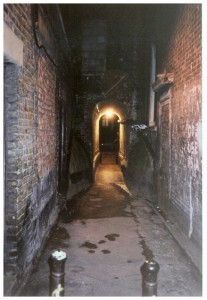 Half an hour later, Policeman Edward Watkins passed through the area and saw nothing out of the norm. Four minutes later, at 1:34 a.m., three men — Joseph Hyam, Joseph Lawende and Harry Harris — were walking north of Mitre Square, near a church entrance, when they saw a man and woman talking. The men stated that the woman was wearing a brown dress atop a black skirt, a black straw bonnet, and a black jacket with a fake fur collar and a piece of old apron — the same clothes that Eddowes was reported to have been wearing that night. The clothes, however, were all the men could see; they did not observe the woman nor the man’s face. The man had towered over Catherine; he was easily 5’8” while she was a tiny 5 feet and plump. She was clearly older than her companion by a good ten years; he appeared to be in his early 30’s. The man was sporting a moustache. He was wearing a dark jacket and dark hat and was carrying a red handkerchief. The woman reportedly braced one of her hands against the man’s chest. The three men did not stare for long; rather, they hurried home. The boisterous Whitechapel nightlife made them uneasy.

At about 1:42 that morning, Officer James Harvey passed the church in the middle of Mitre Square; he neither saw nor heard anything suspicious. Two minutes later, policeman Edward Watkins came upon the bloody body of Catherine Eddowes on the south side of the square. Her skirt was pulled up above her waist and her throat had been sliced wide open. Shockingly, her stomach was also torn wide open; her internal organs were exposed. The intestines were drawn out to a large extent and placed over the right shoulder—they were smeared over with some feculent matter. A piece of about two feet was quite detached from the body and placed between the body and the left arm, apparently by design. Watkins rushed from the scene to find help and quickly caught the attention of George Morris, a night watchman. They both returned to the crime scene. The victim’s flesh was still warm, she had been slaughtered no more than 20 to 30 minutes before the gruesome discovery.
The police were painfully aware that this was the first of the Ripper’s disemboweling murders to be committed on “police grounds.” They took this as a “slap on the face” on the part of the killer, as if he were mocking them.
About 2:18, a Dr. Brown arrived. His report noted that the victim was a middle-aged woman who lay on her back with her head turned to one side. Next to the  body lay some black buttons, a thimble, and a mustard tin. Her eyes, nose, mouth and ears were dramatically sliced and quite unrecognizable; her right earlobe was cut clear through. Her bowels were clearly visible stretching clear to her right shoulder. Catherine’s body was identified, examined and then taken to the city mortuary.
About an hour later, policeman Alfred Long passed along Goulston Street. He found a piece of bloody apron on the pavement. Neatly written in chalk was the message:
“ The Juwes are the men that Will not be Blamed for nothing”.
Some officers thought this message had nothing to do with the recent murders, but Alfred Long told his fellow officers that when he had walked the same path an hour before there was no message; therefore, the writing had to be recent.
 The apron was examined and was determined to belong to Catherine Eddowes. It was and still is the only piece of physical evidence that the police can confidently connect to Jack the Ripper. The note left by the mystery writer was thought to be the Ripper’s “calling card”. Catharine’s friends later reported that she had boasted that she knew who the mysterious killer was and had gone to the newspapers hoping to collect reward money by identifying the killer. Catherine’s explanation as to the Ripper’s identity occurred on September 28th just two days before her final public appearance.
On 1 October, a postcard, dubbed the “Saucy Jacky” postcard and signed “Jack the Ripper”, was received by the Central News Agency. It claimed responsibility for Stride’s and Eddowes’s murders, and described the killing of the two women as the “double event”, a designation which has endured. It has been argued that the postcard was mailed before the murders were publicized, making it unlikely that a crank would have such knowledge of the crime, but it was postmarked more than 24 hours after the killings took place, long after details were known by journalists and residents of the area. Police officials later claimed to have identified a journalist as the author of the postcard, and dismissed it as a hoax, an assessment shared by most Ripper historians.
Click below to read how Jack the Ripper’s first three victims met their grisly fate:
Jack (the Ripper) and Polly, Victim #1: When Love Is Murder
Jack (the Ripper) and Annie, Victim #2: Birth of a Lengend
Jack the Ripper and Elizabeth Stride, Victim #3:The Ripper Hits His Stride
If you enjoyed this article, please consider sharing it!


Jack the Ripper : The Art of Conspiracy
http://historum.com/blogs/jackdaw+1888/918-jack-ripper-art-conspiracy-page2.html
Jack the Ripper : Sickert & The Art of Murder
http://www.unexplained-mysteries.com/forum/index.php?showtopic=23680&st=360
Nice website, Jack. Please do not hesitate to write a post for use about the Ripper mystery should the spirit move you.
Many Thanks for your reply Mr Moore and your comment re my work / studies.
I may accept your invitation.
Regards
Jackdaw
Great, Jackdaw. I am always looking for guest contributions. Anything in depth about theories as to the true identity of the Ripper would be greatly appreciated.
Please feel free to use any of my findings / images secreted within Sickert’s portraits etc etc as posted on the previous links provided, if it assists your cause and website.
Jackdaw would be willing to discuss / debate the same if required.
An ode to the ‘Unfortunates’
The colours of life are but black and white,
As our pencilled in days are drawn by night,
Behind this truth doodles offspring grey,
A shadowy figure the world will say,
His Art depicts the ‘Unfortunates’ fate
And in Hell below hangs their portrait.
Regards
Jackdaw
Perfect. We will examine your material and I’m sure it will help us delve deeper into the endless “offspring grey.”
Perfect!
Many thanks and kind regards.
Have a nice day
Jackdaw – England
Is that really a photo of Catherine Eddowes? I’ve never seen it before.
I’m pretty sure it is, according to the Google image file.
Excuse me….but why did you place those two photos of women to represent Catherine Eddowes and Mary Kelly ?
Inquiring and nosy Ripperologists would like to know. : )
Yours truly
Howard Brown
I’m not sure which photo you’re referring to. There’s one image of Catherine Eddowes near the beginning of “Calling Card.”
The hair of the woman in the photo is very similar to the hair of Catherine Eddows in her mortuary photos, including the texture and the defined part. I notice that the cheekbones are also very similar. It certainly could be her in better times.
To my knowledge there’s only one “living” photo of any of the C5 victims and that is of Annie Chapman with her husband, John. No others, as far as I know, have been verified.
THX for this information.