
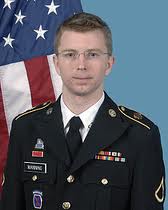
 Former U.S. Army Private Bradley Manning is in very deep guano. While he appears to be in no danger of receiving the death penalty — much to the chagrin of some “true patriots” — he is facing as many as 22 serious charges, including aiding the enemy and unauthorized disclosure of classified information. Manning, who served in Iraq as an information specialist, was arrested in May 2010, when authorities learned that he was responsible for providing the WikiLeaks organization with the largest release of confidential information and state secrets in the history of journalism.
Julian Assange, the charismatic editor-in-chief and de facto leader of WikiLeaks, finds himself in a less perilous, but still difficult predicament. Assange’s life in recent years resembles the plot of a John LeCarre novel, rife with daring and intrigue. After being pursued by a cadre of international police in 2012, Assange was forced to seek asylum at the Ecuadorian embassy in London, where he has been holed up for the past eight months. He is unable to leave the premises without being arrested and expedited to Sweden, where he is wanted on sexual harassment charges that many claim are bogus. Meanwhile WikiLeaks, which has attained worldwide prominence as an “open-source, democratic intelligence agency” committed to publishing secret information submitted by anonymous whistleblowers, now struggles to function effectively. It has been largely shunned by the business community, and harassed and investigated by numerous governments, including the U.S., which continues to ponder the possibility of espionage charges.
Assange and Manning are the public faces of a new breed of political subversive — the cyber-activists and hackers, or “hacktivists” — who have emerged as a potentially powerful force for change in our no longer new “information age.”
 Perhaps the most widely recognized face of this movement is the stylized Guy Fawkes mask associated with the international network of hacktivists known as Anonymous. Anonymous has received considerable attention for its widespread and well-publicized acts of online protest and disruption. Anonymous is not so much a group with members; rather, it is a loose-knit collective that one participates in. This collective’s modus operandi is a unique combination of secrecy and disclosure. There are no membership rules or guidelines; evidently anyone with advanced computer skills can participate, and personal identities are never revealed. The collective has no single set of clearly defined principles or ideology, save for a fundamental opposition to all forces of oppression, in particular anything that prohibits or restricts the free exchange of information.
It would be a mistake to discount the importance of the worldwide hacktivist movement. Likewise, it would be naïve to downplay the significance of Manning’s actions.
 The information he illegally submitted to WikiLeaks included a couple of controversial military air strike videos, “war logs” from Iraq and Afghanistan consisting of nearly half a million documents, and over 250,000 U.S. State Department cables involving embassies and consulates in 180 different countries. All of this leaked material — the largest amount ever published — has proven to be a source of humiliation and embarrassment to government officials and corporate leaders worldwide. The leaked diplomatic cables even played a role in the Arab Spring uprisings. In Tunisia, for instance, the cables provoked mass outrage by demonstrating the extent of the rulers’ corruption — lavish dinners in presidential palaces and beachfront compounds with an army of servants, priceless artwork on the walls, and pet tigers in cages. To add insult to injury, high-end ice cream was flown in from Saint-Tropez. Such information helped incite the Tunisian youth, mired in poverty and deprivation, to take to the streets in anger.
The largest heaping of shame, however, probably fell upon the U.S. government. As Chris Hedges asserted in a March 3 post at truthdig.com.
“Manning provided to the public the most important window into the inner workings of imperial power since the release of the Pentagon Papers. The routine use of torture, the detention of Iraqis who were innocent, the inhuman conditions within our secret detention facilities, the use of State Department officials as spies in the United Nations, the collusion with corporations to keep wages low in developing countries such as Haiti, and specific war crimes such as the missile strike on a house that killed seven children in Afghanistan would have remained hidden without Manning.”
The Obama Administration certainly is not playing softball with Manning, or the hacktivist ethos he represents. The government’s handling of the case has been marked by conspicuous legal aggression. Since his arrest in 2010, Manning has been detained for over 1000 days. Right to a speedy trial? Forget about it. Much of his extended pre-trial jail-time was spent in solitary confinement. Sometimes he was denied clothes, shoes, and eyeglasses. Now, with the legal proceedings finally underway, instead of simply convicting Manning of the ten counts to which he has pled guilty (and which could bring a sentence of up to 20 years), the government insists on moving forward on all 22 charges. This includes the most serious offense, aiding the enemy, which is technically punishable by death. Most likely, a life sentence without parole will be sought. The official position holds that Manning is essentially an “enemy combatant,” and should be treated no differently than any al-Qaida terrorist. Several political commentators have stated that both Manning and Assange deserve to die.
Few people doubt that what Manning did was illegal. The extent of the illegality may be debatable, but at this point it’s safe to assume that he will be convicted and most likely incarcerated for a very long time. Terrorism, however, seems to be a ridiculous, overblown accusation. For the U.S. government, in the wake of the wars in Iraq and Afghanistan, to assert than Manning recklessly endangered innocent lives is ironic, if not downright insulting. We have yet to hear of one concrete example in which the information leaked by Manning caused harm to anyone.
In fact the real question we are left with, regardless of technical illegalities, is whether what Manning did is wrong. This is the serious moral challenge issued by Manning’s first public statement to the court, delivered on February 28th. These remarks, in the form of a 35 page document, from which he was allowed to read aloud as he pled guilty to the ten charges, is remarkable in many ways. Far from coming across as a reckless troublemaker or disturbed head case or embittered revolutionary, Manning demonstrates that he is highly intelligent, quite reasonable, and driven by a strong moral conscience. He does not rant and rave. He does not proclaim his innocence, nor does he deny leaking the information. Rather, he offers a detailed explanation as to why he thought going public with the information was the right thing to do. Consider the following excerpt (transcribed by reporters in the courtroom):
“I felt that we were risking so much for people [in Iraq and Afghanistan] that seemed unwilling to cooperate with us, leading to frustration and anger on both sides. I began to become depressed with the situation that we found ourselves increasingly mired in year after year. The SigActs [reports on military personnel incidents] documented this in great detail and provide a context of what we were seeing on the ground.
“In attempting to conduct counter-terrorism or CT and counter-insurgency COIN operations we became obsessed with capturing and killing human targets on lists and not being suspicious of… cooperation with our Host Nation partners, and [we ignored] the second and third order effects of accomplishing short-term goals and missions. I believe that if the general public, especially the American public, had access to the information contained within the CIDNE-I and CIDNE-A tables this could spark a domestic debate on the role of the military and our foreign policy in general as [missed word] as it related to Iraq and Afghanistan.
“I also believed the detailed analysis of the data over a long period of time by different sectors of society might cause society to reevaluate the need or even the desire to even engage in counterterrorism and counterinsurgency operations that ignore the complex dynamics of the people living in the effected environment everyday.”
This does not sound like treason or terrorism. Nor does it sound like madness. It certainly challenges the prevailing picture of Manning drawn by the mainstream media following his arrest. At that point, many news outlets indulged themselves with certain personal details: Manning’s somewhat troubled childhood, his struggle to come to terms with his homosexuality, his gender identity disorder, his cross-dressing episodes. Now all of this tabloid fodder seems extraneous in light of Manning’s well-reasoned, heartfelt statement to the court. Manning’s description of what he experienced when confronted with the vast amount of damaging information he had access to, his attempt to gain interest from established newspapers (he claims the NY Times and Washington Post ignored him), and his decision to go with WikiLeaks after a period of contemplation and research, adds up to a stunning portrayal of a man who chose to take the moral high road, in spite of the personal risk involved.
 American history is full of figures who demanded the right to question authority, talk back to power, and disobey the rules when they thought the status quo was simply unconscionable. Some names that come to mind are Thomas Paine, Frederick Douglass, Henry David Thoreau, and Martin Luther King. Each of them endured hostility when they decided to take a stand. They were called traitors and subversives. Now they are considered heroes. Manning’s supporters would prefer that we think of him in this historical context. The closest modern parallel is Daniel Ellsberg, whose leaking of the Pentagon Papers in 1971 exposed the massive public deception involved in waging the Vietnam War. At the time Ellsberg was vilified by many as a treasonous criminal. By now, the great majority of us have a quite different opinion. In the same way, Manning’s status likely will be bolstered by his long-awaited statement to his accusers. In an excellent piece for The Nation, Kevin Gosztola argues that Manning, far from being dangerous or irresponsible, fits the classic mold of the “heroic whistleblower.” What he has done is not all that new, in other words, and we need to be aware of the historical precedents for his actions, rather than get swept up in the rhetoric of the moment regarding the “War on Terror.”
It is worth noting that the same media outlets that were so eager to feast on the information Manning provided (via WikiLeaks) when it served their own interests, and were then quite happy to snack on the juicy cross-dressing details once Manning was arrested, are not quite ready to devote much time or energy to his trial — even though one could argue that his is the most important criminal trial of our era. In a recent article for The Huffington Post, Edward Wasserman excoriates the major news corporations who have apparently “thrown Manning to the wolves.” Wasserman writes, “He was a great source. His information was solid. The world’s best news organizations believed it was of immense public value. So now he goes to jail, perhaps for life, and the media stand in silence?”
If Manning is the Daniel Ellsberg of our time, then many of his hacktivist allies in Anonymous might be seen as the modern-day equivalent of the Weather Underground or the Baader-Meinhof Gang. Instead of bombing buildings, however, now the targets are web sites and databases. It’s a far less dramatic, and far less bloody, approach to political action. There are no gunfights in the streets, no kidnappings, no jail breaks, no conventional weapons. Rather, Anonymous utilizes decidedly more geek-like methods such as “distributed denial of service” attacks, database information hacks, and website defacements. Tools of the trade go by names such as Internet Relay Chat and Jabber. Associates attend “chaos communications conferences” around the world. This all may sound relatively benign, given the violent realities of world politics. Yet make no mistake, the potential threat posed by groups such as Anonymous could be more far-reaching, and more effective, than anything the urban guerrillas of the 1960s and 1970s ever dreamed of. Consider the following accomplishments attributed to Anonymous in just the past few years:
- Project Chanology, featuring worldwide protests against The Church of Scientology.
- Extensive coordination of Occupy Wall Street activities.
- Bay Area Rapid Transit (BART) hacked, and personal information released in retaliation for BART halting wireless service during the Oscar Grant trial protests.
- Multiple attacks on Westboro Baptist Church for preaching hatred toward homosexuals. Anonymous vows to destroy the church. Church website hacked, with release of all church members’ personal information. Minister’s Twitter account hacked.
- Takedown of Lolita City website, a secret source of internet child porn.
- Simultaneous crashing of FBI and Department of Justice websites (in response to government crackdown on file-sharing site Megaupload); websites belonging to the Motion Picture Association of America, and the Recording Industry Association of America, Broadcast Music, Inc. also crashed.
- Coordinated attacks against companies that shunned WikiLeaks in the wake of political controversy. These include MasterCard, Visa, PayPal, and Bank of America. Security specialist company HBGary Federal (which was part of BofA’s attempt to bring down WikiLeaks and Anonymous) has its website hacked. Tens of thousands of emails and documents were posted online. CEO’s Twitter account was usurped.
- Numerous government websites in the United Kingdom crashed in protest of extradition and surveillance policies.
- Ugandan government websites hacked in protest of pending anti-homosexuality legislation.
- Genetically modified crops website crashed.
- Takedown of GoDaddy.com’s Domain Name Servers, affecting small businesses worldwide.
- Series of attacks on Israeli government websites in protest of the brutal treatment of Palestinians.
- Operation launched to shut down all Syrian government websites in protest of government attempts to silence opposition during civil war.
This is quite a resume, and we have no reason to assume that such activities will slow down anytime soon. If anything, the attacks may accelerate. In February 2011, the English language edition of Al Jazeera published an opinion piece written by an unnamed (obviously) member of Anonymous. Among other heady claims, the author throws down the following gauntlet, which serves to sum up the group’s attitude: “This is the future, whether one approves or not, and the failure on the part of governments and media alike to understand, and contend with the rapid change now afoot, ought to remind everyone concerned why it is that this movement is necessary in the first place.”
Website defacement might appear to be no more than a costly prank. For many organizations, however, the disruption is tangible. A crashed website results in an inability to conduct business as usual. Furthermore, if the same skill set required to crash a website or hack a Twitter account can also be used to penetrate firewalls protecting vast amounts of security data and financial information, the potential for serious damage is very real. And we all have to assume, at this point, that many of our society’s most important networks are not really all that secure. Consider the threat caused by the rise in cyber-crime all across the globe.
One of Anonymous’s most recent high profile activities bears special consideration, as Bradley Manning’s legal battle drags on. In January 2013, Anonymous launched what they referred to as “Operation Last Resort.” This included hacking into the website of the U.S. Sentencing Commission, successfully crashing the site and dropping it from the Domain Name System, yet leaving the IP address intact to display the defaced site’s contents. “Operation Last Resort” was initiated in response to the recent suicide of hacktivist Aaron Swartz, which Anonymous viewed as a “line that has been crossed.” Swartz, widely considered a genius in the field of information systems, was being prosecuted for hacking into an MIT database and stealing a number of technical journal articles. Many have concluded that Swartz’s suicide was caused in part by overzealous prosecution by the Department of Justice and the “bullying” use of outdated computer crime laws. For Anonymous, this was a call to arms. The Sentencing Commission website didn’t stand a chance.
The mainstream media may have lost interest in Manning, but hacktivists worldwide are no doubt paying very close attention to how this case proceeds, as well as to the plight of Julian Assange and the WikiLeaks organization. If and when Manning is convicted of serious crimes with the potential for a truly draconian sentence, we should not be surprised to see a virtual wave of retaliation.
posted by BJW Nashe on March 25, 2013
If you enjoyed this article, please consider sharing it!


I think another dimension worth considering within the prosecution of Bradley Manning is the non-remorseful informant, Adrian Lamo, whose cooperation with the Department of Defense was pivotal in bringing charges against Manning through information revealed from online chats that took place between the two. Adrian Lamo, according to a Guardian interview (http://www.guardian.co.uk/world/2013/jan/03/adrian-lamo-bradley-manning-q-and-a), reassured Manning in these web chats about his trustworthiness, telling him he was a journalist and a church minister and that either way he’d have legal protection against his identity being revealed. After being asked whether his actions and cooperation with the Department of Defense were misleading, Lamo expresses no regret for having participated in the prosecution’s efforts. Now Manning faces the possibility of a lifetime sentence for his actions.
Thanks for bringing up this important piece of the puzzle, and for linking to the interview with Lamo. If Lamo hadn’t gone to the authorities, Manning might have never been arrested.
It’s certainly easy to see Lamo as no better than a rat or snitch in this case. By assuring Manning that their online chats would be kept confidential, and then turning Manning in, Lamo doesn’t look like much of a hero. The best we can say about him is that he was put in a difficult position. Who knows what his real motives were? He claims he thought Manning posed a real threat.
Lamo’s own relationship to the hacktivist movement is of course problematic. He was convicted for hacking in 2004, I think. And now he’s been vilified for his treatment of Manning. So any of his justifications after the fact are probably best seen in this conflicted context.
I do find it odd that Lamo would not express more remorse over what has happened to Manning. Lamo seems at times too close to viewing himself as one of the victims in this case. That’s a stretch.
It always amazes me how the America public is duped to believe the good guys are the bad guys and the bad guys are the heros. When will the American public wake up? Maybe when enough Bradley Mannings are willing to risk their freedom and blow the whistle! Thanks for your in depth analysis, hopefully justice will eventually prevail and the real American heros will be recognized.
Yes, in any just society Manning would be pardoned and put on probation. He’s already been through enough. He doesn’t pose any danger to anyone. The Obama Administration, I regret to say, is wrong on this one. And too many Americans don’t even know what’s going on.
Yes, in any just society Manning would be released and put on probation at this point. He’s already been through enough. He poses no threat to anyone. The Obama Administration, I regret to say, is wrong on this one. And their hard-line approach will only serve to further galvanize the hacktivist movement. Perhaps at some point Manning will be pardoned, but I don’t know. History will probably be kind to him, though. He will be known as something of a hero.
It should be pointed out, for all interested citizens, that Julian Assange was raised in an Australian Orphanage/Cult where all the striplings/acolytes were as blond and blue-eyed as could be found.
He grew up on a farm. He and his fellow unpigmented orphans and kidnap victims were the crop.
The idea that the snot-nosed Assange and the boyish Private Manning conspired to defy the Pentagon, confound the Media and the World with their “leaking,” does not hold water. Or mucus. Or anything else that might leak.
Well, Assange’s upbringing was different than most. Interesting that you should bring up the “cult,” with striplings/acolytes and kidnappings and whatnot. I have to say I didn’t know he was raised in the Australian chapter of the Westboro Baptist Church. Thank you for pointing this out. It’s all starting to make perfect sense. And you indicate the importance of “farming,” cleverly nudging us in the direction of bestiality. Just imagine the orgies…
And yes, all of that confidential material leaked to the public–it can’t be just the result of Manning and Assange. But who, then? Was it the damn Russians?
Thanks for the comments. I gotta go now. I’m going to be late for a Satanic ritual.
Check out this reading material on Assange:
http://www.amazon.com/WikiLeaks-Inside-Julian-Assanges-Secrecy/dp/B0057D9LJG/ref=sr_1_4?s=books&ie=UTF8&qid=1364397779&sr=1-4&keywords=julian+assange
Despite assiduous effort, I gradually, reluctantly came to be all too aware of the uniformed and chipmunk-faced Bradley Manning, he of the jaunty cap, through constant insidious and invidious media coverage. I gleaned from the overarching ubiquitous coverage that Manning was associated in some way with Julian Assange.
This brings me to my point at long last.
Assange was raised in a Cult which farmed blond, blue-eyed boys and girls for unspecified purposes. I guess one purpose could be to become an international sensation, thumbing ones nose at America from an embassy in Ecuador. “Nanny, nanny boo boo,” the effete albino seems to be taunting, and no one, not the Congress or the President or the Pentagon or the combined forces of the CIA, FBI, NSA and the ETC can get to him.
As an evil/benevolent genius, he is smarter than all of them.
America is split 50/50 opinion-wise, on the issue of whether the creepy mind-controlled, inexplicably promoted and protected weirdo Assange is a hero or a villain.
Manning? I don’t know anything about that dude. As stated above, I only gradually and reluctantly was made to be aware of him despite my aforementioned assiduous effort.
There are no actual heroes or villains in this story, just actors.
Bad actors for sure, but we seem to like the script anyway.
Thanks fur further comments. I wonder if you might be overstating the case in regard to Assange’s cult upbringing. Do we know for a fact about the “farming” implications? What’s the source material for this? And does the “cult” have any bearing on Assange’s subsequent WikiLeaks activities?
As far as heroism goes, people will draw their own conclusions. If you think that exposing the secrets of imperial power is a good thing, you’ll probably find Manning and Assange to be heroic. If you believe in an unfettered free press, you’ll probably appreciate WikiLeaks. Sometimes the heroes are also troublemakers.
Perhaps the best approach is to view the whole WikiLeaks saga as a highly complicated affair that is still being played out. Perhaps Assange is neither hero nor villain; but he his certainly more important than a mere “bad actor.”
Here are some links. I have not read through them all nor can I vouch for their veracity, but a recognizable pattern emerges.
“Telemovie says hacker martyr’s infant escape from cult sparked activism.”
(If you believe that I have not one but several bridges to sell you.)
http://www.theregister.co.uk/2012/10/04/assange_movie_review/
http://www.henrymakow.com/stranger_than_fiction_life_of.html
http://en.wikipedia.org/wiki/The_Family_(Australian_New_Age_group)
How does Julian’s cult affiliation affect our lives and politics? We are still talking about him aren’t we? Many years hence? We still hang on to the notion that he’s some kind of hero despite overwhelming evidence that he is a stooge manufactured in a laboratory.
He is a brainwashed clown promoted and protected by his creators.
Who his protectors are is a matter of speculation, but they are almost certainly not good people.
It does seem like there might be something to the theory that Assange’s upbringing did not quite follow, shall we say, the middle-class norm. That being said, however, I don’t see how that detracts from his work on Wikileaks unless you are suggesting that Wikileaks too is all just part of some vast unholy conspiracy.
I checked out the links. Very interesting and very scary. A sort of Australian New Age M.K. Ultra. It sounds like Assange has little memory of those years. I don’t blame him.